Partnerships + Crisis = Innovation and Change
I have always been interested in change and what can drive change. Yet, taking great ideas and implementing them at an organizational level is a challenge in both public and private sectors. When I look back at the past few years, some of the bigger humanitarian information management “shocks” have come at the time of crisis - recognition of digital abilities as a result of the Haiti earthquake (Disaster Relief 2.0), the UN’s first ever online crisis map in response to Libya, the FEMA Innovation Team in response to Hurricane Sandy, the UN’s first ever official map made up of solely social media data in response to the Philippines typhoon Pablo, and so on.
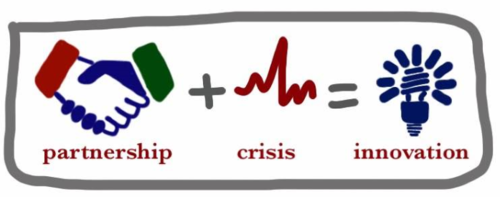
Charles Duhigg mentioned in “The Power of Habit: Why We Do What We Do in Life and Business” that during turmoil organizational habits become malleable - to the point that people “understand that things must change and are willing enough to overhaul the patterns they live with each day”. So, crisis of any form (e.g. natural disaster, financial crisis, management crisis, etc.) can be an ideal time to push through new ideas. But, when looking back at the examples that I mentioned I felt that there was still a key aspect missing.
When collaborating with Annie Waldman and Shadrock Roberts to author Guidance for Collaborating with Formal Humanitarian Organizations, I had the fortunate pleasure to read through the interview notes that were gathered from over 40 interviews. What become apparent to me was the pre-existing relationships that respondents mentioned and how the innovative projects that they carried out were the result of having met or worked with someone before the crisis.
Yet, I wondered to what strength that relationship had to exist in advance. Douglas Rushkoff, in “Present Shock: When Everything Happens Now”, mentions that in regards to social media and relationships that “we want to speak with one another” in person. Looking back at the interview notes, I found that people talked about having physically met the people who they drove innovative change with during a crisis situation. So, it was not just having connected, but having met in person. When I examine my own relationships I know that it is easier to initially collaborate if I have met someone in person….even if just for a few minutes. I just met a few digital humanitarians a couple weeks ago at the ECOSOC Humanitarian Innovation Trade Fair and I will be much more willing to collaborate with them in the next crisis - even though I knew beforehand that they were great people.
In the Libya Crisis Map example, my office needed situational awareness and support compiling the Who’s doing What Where (3W) product. Even without access to the country, we still needed this information. Thus people were more willing to try a new approach. I called an initial teleconference with a few Volunteer & Technical Community focal points that had I met during an exploration phase after the Haiti earthquake. The result was the Libya Crisis Map and significant support collecting 3W information. So, combining the times of a crisis with pre-existing relationships, we drove forward a first-ever for UN-OCHA.
Having launched the Guidance for Collaborating with Formal Humanitarian Organizations today, I believe that one of the most important aspects is to get out there and meet people in person. There are great annual conferences and simulations like the International Conference of Crisis Mappers, ISCRAM, Crisis Common’s Crisis Congress, RHOK, State of the Map, and so on. Find the one(s) that will be most relevant to you or your entity and get people out there. The impact may not be immediate, but it may become extremely apparent during the next crisis when you open up and collaborate in ways that you had not expected before.
Dennis Miletti mentions in some of his research that during the times of a disaster, people relate to other people rather than relating to each other through their organizational roles. So, get out there and meet other humanitarians so that you are ready to relate as a person and to be part of the solution.
I hope to see you there.
Andrej