The Humanitarian Ring
A couple months ago I came across a recently-closed Kickstarter campaign simply called the NFC Ring [website] and it started me pondering about the possibilities that such wearable tech could have in the humanitarian sphere. Although wearable tech has been around for a while, it seems only recent that such tech is becoming small and un-burdensome enough that they are hitting the mainstream. I even wear a Swimovate watch to track my swimming data which was something inconceivable just a few years ago.
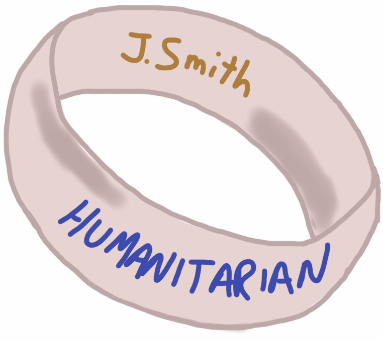
One of my initial thoughts was: How could such a humanitarian ring be used to help the Humanitarian contact list problem (see Humanitarian ID described)? Although a seemingly dull product, the Humanitarian contact list is one of the most important products in the early phases of a new emergency. So, my initial thoughts were about humanitarians arriving in emergencies with an encrypted Humanitarian Ring which they could scan at the emergency reception desk/centre thereby automatically adding all their details into the contact list. As the emergency moved forward, they could scan their ring at a coordination centre before asking for information/maps thus verifying that information is being released to a trusted individual. But, it would still leave the contact list “check-out” element a challenge. Perhaps connecting the ring to a location aware mobile app could help figure out the puzzle? And, who gets to certify if someone is a humanitarian?
But, over the past couple of months and while reading Rober Scoble and Shel Israel’s new book - Age of Context: Mobile, Sensors, Data and the Future of Privacy - which discusses the perfect storm being created by the combination of mobile, social media, big data, sensors, and location-based technologies, I have realized that a NFC ring could be applied in a variety of interesting ways and perhaps solve several challenges we face. Here are a couple that I have been thinking about recently.
1. Humanitarian Response Teams. As a member UN Disaster Assessment and Coordination (UNDAC) I could imagine the system issuing each UNDAC member a ring that holds their encrypted details (e.g. basic profile, UNDAC-specific information, emergency contact info, vaccination details, finger-print, photo etc.). What would the ring do for an UNDAC member? Besides subtly distinguishing them without having to wear their full gear, it is probably only our imagination that will limit us. Tracking member movement for security purposes by checking-in/out of their emergency offices would be of great value. Gaining access to authorized vehicles in a similar concept to ZipCar would alleviate a lot of the transportation challenges the teams often face. Gaining access to secure areas (e.g. camps) when the finger print and photo on their ring match those taken at the camp entrance would facilitate movement and assessments. Medical emergencies of team members could be more quickly addressed (e.g. reading the device by another team member could provide medical history). Wearable tech could really aid responders in their security, movement, and overall response to an emergency.

2. Refugees. Although UNCHR is issuing smart cards in many locations [which will remain important as an identity card in almost all countries], I wonder if an encrypted refugee ring could also be an important piece of tech to offer as aid. Protection of the affected is always of utmost importance. Imagine controlling access to and even movement in a camp based on such rings. Imagine being able to authorize access to something like an AIDBox which would dispense items based on input from a mobile-enabled camp manager (or even someone based remotely). By combing a refugee/affected ring, a smart phone, the Humanitarian Concierge and AIDBox, we would be bringing the affected population rapidly back into the networked age.
These are a couple initial ideas. Combining such ideas with more predictive analysis, such as ACAPS research into mobile movement patterns during major holidays in order to predict likely movement in crisis, could really advance the humanitarian service level to new heights.
If you have any ideas on how a humanitarian ring could be used or if you would be interested to get the idea started, please leave a comment below.
Andrej