Humanitarian Data Scientist - who and how?
We have all heard and seen the trend of increasing volumes of data becoming available to us through a variety of mechanisms. With this trend, we have also seen the increased recognition of those who know how to handle such data. Historically, we may have referred to them as statisticians. However, as technologies in this discipline have multiplied and become affordable (or free), increasing numbers of people have been empowered to enter the business. And, the title Data Scientist has quickly entered our vocabulary.
In the summer of 2013, I was joined by Annie Waldman, a Masters student in Data Journalism at the time, and we had several great conversations about data, data journalism and the likely impact it would soon have on the humanitarian information management officers (IMOs). One element of these discussions turned into a collaboration with Daria Kireeva who drafted out Guidance on Appropriate & Impactful Comparisons in Humanitarian Crisis. We recognized that with increasing data availability in our emergencies, IMOs would need to be ready to leverage it in creative ways.
Yet, I realized that we had not stopped to define a Humanitarian Data Scientist. What skills do they need? What tools will they use? What qualities must they possess? In the slew of Data Scientist graphics and articles available online, I stumbled upon a great graphic from Marketing Distillery in late August. Perhaps the most appreciated aspect was the stressed need for data scientists to possess domain & soft skills as well as communication & visualization abilities on top of the regular data, statistical and programming expertise that we expect. So, using the graphic as inspiration, Hildemar Cruz worked with me to define a Humanitarian Data Scientist. Below is the resulting graphic.
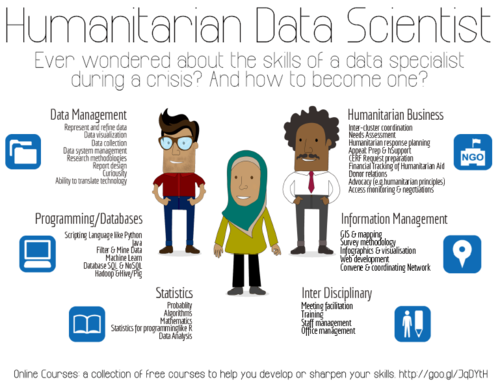
You can download the editable PDF with all three characters (5MB), only the white male (5MB), only the black male (5MB), or only the female (5 MB). Feel free to edit and customize to your needs.
In our search, we found a general weakness in existing graphics. They tended to either simply list the skills you needed or the applications you could work in (for the technical elements). Nothing seemed to go that step further to outline where to find training to either turn yourself into a data scientist or sharpen your existing skills.
With this in mind, Hildi set out to find free Massive Open Online Courses (MOOCs) that corresponded to the different skills that were listed in the graphic. The resulting list is linked on each infographic and is available as a Google document where you can comment and suggest other relevant courses. One note: when looking for courses, Hildi aimed for free courses available from the larger, more recognized institutes. This filter does not imply that other courses are of poor quality but rather that we were simply not able to evaluate everything available.
So, if you have ever dreamed of being a humanitarian data scientist, hopefully this list of MOOC courses will put you on the right path.
Special kudos to Hildi as I know that compiling the list and creating the graphic took a lot of work.
Andrej