Humanitarian Research - How to approach it?
At the same time as demands are increasing on the humanitarian sector, the number of academic fields and institutions studying humanitarian response is increasing. Combining that with the rapidly expanding amount of information and data being produced, collected, stored and analyzed, the humanitarian information management field is being approached by more and more researchers hoping to “study” us. Sometimes this request is a simply survey or a short interview. But, other times, organizations or academics want to undertake a much more in-depth project. They want to go to the field. They want to show up in a new emergency with the first responders. They want to know what decisions are being made, who is making them, and how information/products are being used in those decisions.
A few months back, while I was attending 2015 Information Systems for Crisis Response and Management (ISCRAM) conference, several people approached me about wanting to “study” OCHA and humanitarian emergencies. That prompted me to pose the following question: What makes a good humanitarian researcher? For that matter, What makes a constructive humanitarian organization? Great conversations with the likes of Bartel Van de Walle, Tina Comes, Kenny Meesters, Roxanne Moore, Helen Campbell, and Per Aarvik ensued. Several interesting ideas were discussed.
In order to get the conceptual idea formalized, I worked with Katie Whipkey. She spent time talking to experienced humanitarian researchers and studied different partnering models that the United Nations uses. The result is a succinct three page document [PDF] outlining the benefits of a collaborative humanitarian research arrangement to a humanitarian organization, its benefits to a researcher, and most importantly its characteristics. What type of characteristics (experience & skills, personal traits, and research competencies) would be expected and duties (operational and data management) could be taken on by a researcher. For an organization, the paper discusses the operational and philosophical environment it would need to provide as well as its obligations, pre and during crisis, to a researcher, in order to foster a truly collaborative and beneficial research arrangement. The paper also provides a great list of the generic categories that academics often want to study within the humanitarian sector.
Ignacio Gimenez-Rebollo, working with Katie, turned the concept into a wonderful infographic.
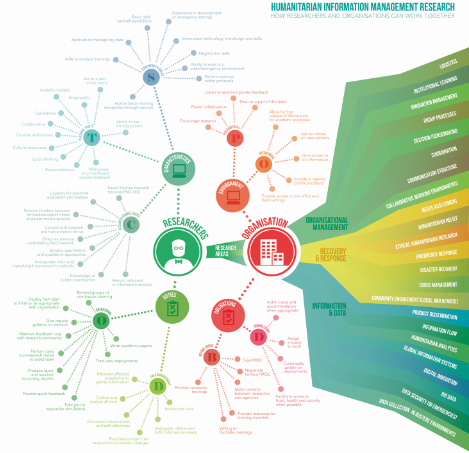
[Download PDF with graphic | 1 MB]
I expect that there will be suggestions that may surprise you. For example, expecting a researcher to dedicate a percentage of time to help the organization on non-research tasks (e.g. 10% time helping to run a reception desk) may seem strange. But, this arrangement would integrate the researcher into the team, expose them to the challenges of humanitarian work and perhaps open unexpected insights. Organizations providing logistical support and accommodation and being included on internal communication may seem far fetched. Yet, we found it happening with other partners. I suspect arrangements with great partners like International Humanitarian Partnership could help to ensure a bed and food. Everything is possible.
It will definitely be a “two-way street” to make this concept work. But, for organizations serious about (real-time) learning and evaluation, such an arrangement will make them a much faster adaptor during a crisis and an overall better service provider.
Andrej