Guidance for incorporating big data into humanitarian operations
When discussing big data, I often encounter three different groups of people. One believes that big data will solve all major humanitarian problems; another can bluntly state that big data is a complete waste of time; and the third has no idea where to start but are pressured by their management to leverage big data for its perceived advantages. In the past, I fell squarely in the third group. And, often, I still find myself struggling there.
After presenting at a conference a few years ago, I was approached by a military officer who wanted to talk to me generally about data integration. He proceeded to mention that they simply considered all new data sources as an extra stream for their existing processes and products. I had, while talking to him, a “light bulb” moment: we do not need to create new products solely based on big data. We need to find ways that these large and dynamic data sources could be filtered and used to augment existing data sources. Combining new data with traditional data would mean that we could create more complete products. Products that humanitarian responders already know and understand. We could then paint a more complete picture while avoiding introducing new products that take additional time and energy to adopt.
A couple concrete examples of where I have used this approach include Libya (2011) and the Philippines (2013). In Libya, UN-OCHA partnered with the Standby Volunteer Task Force (supported by Humanity Road) to scour online news and social media (i.e. big data) looking for information about ongoing response. That data was then used to create UN-OCHA’s 3W product, which was shared widely and posted on conference walls in Cairo, Tunisia, Geneva and UN-HQ New York. Given that the data was included in a product that responders already knew and understood, it was easily digestible.
In the Philippines, UN-OCHA partnered with the Digital Humanitarian Network and the Qatar Computing Research Institute to again search social media for 3W data. The result? The first 3W product released contained approximately 40% of its data from big data sources. Again, we augmented one of our standard products that responders knew.
Despite these successes, I recognize that there is a lot more to consider when integrating big data. And, I know that many others are grappling with the same questions. So, I set out with Katie Whipkey to create something that would help anyone facing these challenges. I am excited to now share our result: Guidance for Incorporating Big Data into Humanitarian Operations.
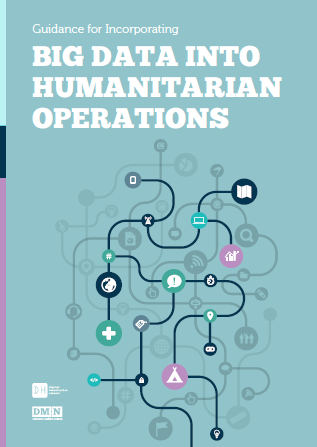
PDF: English (2015) | Arabic translation (2018)
This guidance is intended to assist information or data focal points in humanitarian organisations to understand the variety of, categories of, and possible approaches to integrating big data into their organisations. The work discusses the benefits and risks one may face. It covers topics such as internal organizational considerations, data pipeline and acquisition issues, policy considerations, contextual requirements, and the big data wheel. The guidance also provides checklists to help anyone start down the path of integrating big data into their humanitarian response efforts.
Andrej
Kudos to Ignacio Gimenez-Rebollo on the document design and layout work.