Sovereignty in the Digital Era & Long-Term Trends in International Disaster Response
When a major humanitarian disaster strikes, international organizations can only respond if a country’s government specifically requests the support. Generally, such a request occurs if the national capacity finds itself beyond capacity due to the size of the disaster. A few years ago, a country suffering from a major disaster specifically requested no international organization assistance. Yet, local response actors were asking for support - especially in the the information management discipline. A request was made through digital channels and several digital humanitarian organizations, with members spread around the globe, stepped up to help. Despite sovereign countries being able stop foreign organizations from entering or sending goods into the country they cannot so easily stop remote, digital support. And, this got me thinking: How are digital technologies impacting the concept of sovereignty during disasters? Sure, things have generally changed and adopted since John Perry Barlow’s 1996 Declaration of Independence of Cyberspace [PDF], but what about during the times of crises?
I posed the question to RJ Reid this summer and he began researching the topic. Although we uncovered very little material on the specific topic, RJ was inspired by what he found in regards to the concept of sovereignty and how it has been impacted historically over time with respect to disaster response.
But, how could we select and compare disasters? And, what is a sufficient time period to analyze? In the end, we settled on two major disasters: the 1907 earthquake in Kingston, Jamaica and the 2010 earthquake in Port-au-Prince, Haiti. Both were of similar magnitude, both occurred in Caribbean island capitals, and both happened mid-afternoon in January. 100+ years gave us a sufficient time period to see the larger trends.
Looking at the 1907 response, the 2010 response and a likely future response, we reviewed seven major trends:
- Alerts;
- Mobilization;
- Information Communication Technology;
- Delivery;
- Finance;
- Non-Governmental Organizations;
- International Cooperation;
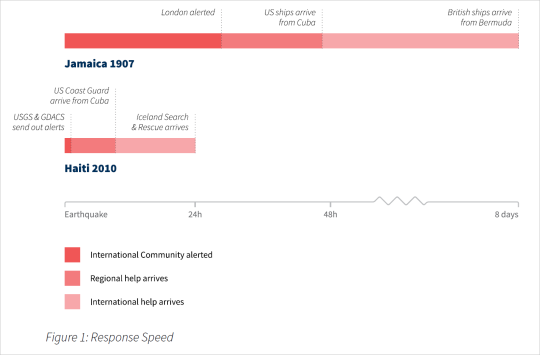
The most obvious trend when evaluating the responses is the rapid increase in the speed of the response. It took over a day for the British Government to be notified of the earthquake in Jamaica, but less than half an hour for multiple official alerts to be issued about the earthquake in Haiti. Only three ships arrived in Jamaica within the first week, but 26 international search-and-rescue teams arrived in Haiti within three days. And it took days for a response fund to be established in London for Jamaica relief, yet CERF released $10 million for Haiti relief within 24 hours.
 Between 1907 and 2010, advancements in technology and the establishment of organizations and processes led to drastic improvements in international crisis response. Technology and organizations will continue to evolve over the next 100 years in new and exciting ways, and the outcomes of crisis response will not remain static under these changing conditions. While the twentieth century saw crisis response improve mainly by advances affecting speed and capacity, it appears likely that emerging technology and organizational reform will instead advance the response in terms of overall quality. Progress will be made in the effective and efficient mobilization of resources and delivery of key services, stemming largely from technology that connects and enables various actors, as well as a shift in international organizations from providers to coordinators.
So, although we did not come up with a clear, definitive answer to how digital technologies will impact sovereignty, we did find long-term trends that seem to indicate the areas where disaster response will see the greatest impact and improvements over the coming century.
Andrej