The infodemic wave & the humanitarian sector. Are we ready?
Ensuring that people have trustworthy information is not a new challenge. Yes, it predates the Internet….it is as old as humankind. But the scale of the challenge has been growing exponentially over the past decades as technology becomes more and more advanced.
By chance, I recently watched the Seinfeld episode The Old Man (Season 4, episode 18, 1993) where Kramer pushes a conspiracy theory regarding senior citizens. And, when asked where he gets his information Kramer replies: “The alternative media, Jerry. That’s where you hear the truth.” Kramer’s comments sent me on a bit of a hunt. Since 1993 was extremely in Internet-era, I assumed that his comments were likely related to other forms of media. In an interesting Reddit post discussion [PDF], one responder noted that New York City “was the center for any number of independent newspapers, magazines, and underground publications”…..that…. “were often small enough and idiosyncratic enough to publish views startling at odds with that of major metropolitan newspapers like the New York Times”. The author also outlined something called public access television where private citizens were given airtime for their own programming (starting in the 1970s) and that such programming would have easily been available through a cable subscription. As well, unlicensed radio stations (aka pirate radio) often broadcasted on commercial frequencies.
Returning to current times, nearly everyone has been enabled by the Internet to share information almost instantaneously around the world. While this empowers amazing learning and collaboration, it comes with a dark underside - mis and disinformation actions by nefarious actors. How bad is the problem? Gartner has predicted that, by 2025, 25% of the world’s news and video content will be proven false by countering deep fake technologies! And, that a lot of data scrubbing will be required before strategic decisions can even be made confidently…..as one must make sure they are using the right information.
Media outlets like the BBC have already created dedicated units to help counter disinformation. Development entities - like Creative Associates - have created positions [PDF] to design their approach to information disorder / disinformation. Yet, the overall humanitarian sector seems to be a step behind. As The New Humanitarian notes [PDF] notes in regards to the Ukraine response, the humanitarian sector must realize that we can become the target of coordinated disinformation campaigns. It would not be hard to imagine a humanitarian organization, under intense time & life saving pressure, making a decision based on incorrect information.
It is under this context that I was very happy to have worked with Kristen Pearn on a new paper - Mis & Disinformation - Handling the 21st Century Challenge in the Humanitarian Sector. We found that the humanitarian sector has been affected by several infodemics* in the past decade. And, while a few organizations have taken steps to implement measures to monitor and counter misleading content, the sector has not dedicated sufficient analytical resources to implement the prevention and mitigation measures commensurate with the threats posed.
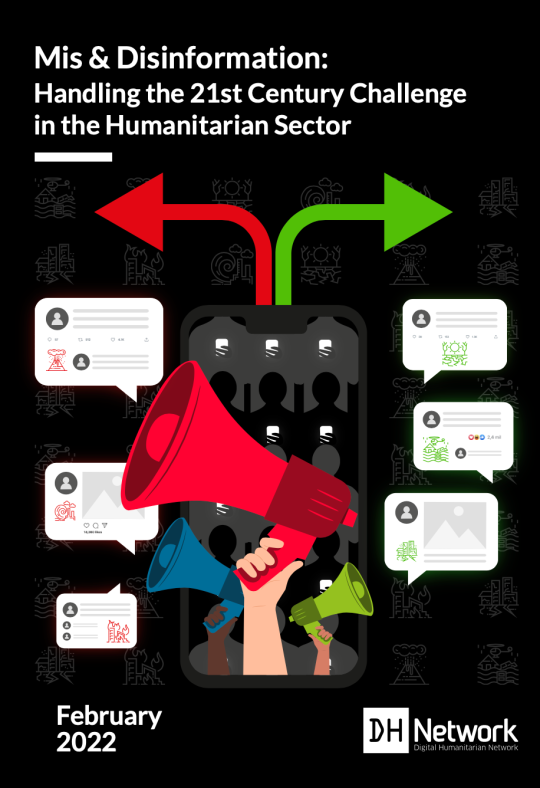 [PDF]
To help mitigate future threats, the humanitarian sector must fundamentally rethink its approach to mis & disinformation and improve its communication strategies, cross-sector collaboration, standardized processes, and online & offline engagement with affected communities. No easy task, but one that will quickly become essential. The good news is that those who are involved in such work are already making their strategies and tools available online. The report’s annex compiles several resources, such as Internews’ Disinformation Toolkit, to help get you started.
Andrej
* The term ‘infodemic’ first emerged during the SARS epidemic outbreak in 2003. In an opinion piece for the Washington Post, political scientist David J. Rothkopf described the information landscape as: “A few facts, mixed with fear, speculation, and rumor, amplified and relayed swiftly worldwide by modern information technologies, have affected national and international economies, politics, and even security in ways that are utterly disproportionate with the root realities.”