The Information Age & The Need for New Humanitarian Principles
During the Age of Enlightenment, the church, holding onto moral claims that it saw as absolute, was unwilling to bend, reluctant to reinterpret and unwilling to embrace what it had no chance of stopping. As a result, its sizable influence was significantly eroded and never returned. In today’s era, every major organization and sector - including the humanitarian sector - is presented with a similar challenge: the Information Age.
When Oscar Tequeda joined me earlier this year, the question that set off our research was “How can humanitarian organizations partner with what may seem like ethically questionable technology companies?”. Our research took us along a fascinating path where we got to interview amazing people from across the spectrum - from those who argued the sector should fully embrace tech companies to those who argued the sector should only be using open-source solutions.
Our resulting paper, Where Technology Meets Ethics - The Humanitarian Principles and Their Problematic Relationship to Technology, ended up exploring how the current humanitarian principles are actually holding the sector back from adjusting to the Information Age. At times, it became very apparent that these principles were even in complete contradiction with each other when talking about technology, information and data.
 [PDF]
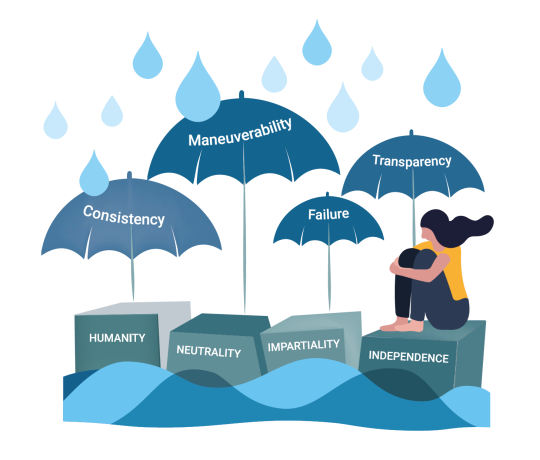
While the current humanitarian principles are excellent guides for a sector attempting to navigate the difficulties of politics and national interests, their application to technology and technology companies may not be the best route forward. Therefore, we have suggested implementing four additional principles for navigating the sector’s relationship with technology:
- Consistency. Are we staying consistent in our efforts to adapt to technological change while still providing the maximum aid possible?
- Maneuverability. Are we staying flexible enough to successfully maneuver through the constant changes of the Information Age while still providing the maximum aid possible?
- Transparency. Are we remaining transparent in our moral reasoning and corporate agreements regarding technology and data, admitting when it is problematic and requires adjustment?
- Failure. Are we embracing our failures in our relationship with technology and data, accepting them as a natural consequence of forward movement?
 In every interview, the WFP-Palantir agreement was brought up by the interviewee before we prompted it. Given the awareness of this agreement, we used it as a case study in the paper and applied the four new principles as a way to show how constructive these additions would be in framing and deciding on a partnership.
The 21st century will continue to change the status quo. If the humanitarian sector wishes to prosper it will have to adjust to the new realities of a world defined by the rapid introduction of advanced technologies and a global political system undergoing a massive transition in uncharted waters.
Andrej