Humanitarian Emergencies - Puzzles or Mysteries?
Quite often during the early days and weeks of an emergency, I hear people asking for more data or information. This is a very common occurrence, but I often struggle with how to stop people from demanding more information and to instead focus on understanding what is already available. I also see that most information professionals who support these decision makers in turn demand more data from humanitarian partners and produce more products. In my reading pursuit to help my own understanding, I read several decision making books including a couple great ones from Malcolm Gladwell (Blink & What the Dog Saw: And Other Adventures) which really helped. And, one of the more interesting analogies that Gladwell used was the idea of a Mystery vs a Puzzle in regards to data/information requirements in decision making.
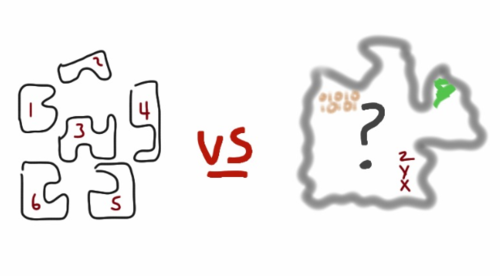
To outline the difference between a puzzle and a mystery, he used the following example:A puzzle = What was Osama bin Laden’s whereabouts? A mystery = What would happen in Iraq after the toppling of Saddam Hussein? Gathering more data will help us to solve puzzles, but not to solve mysteries. Mysteries require sense-making more than data. Often adding data to a complex situations create conflict with existing data thereby making the situation even more uncertain and more difficult to make a decision.
Gladwell notes that “…the distinction is not trivial. If you consider the motivation and methods behind the attacks of September 11 to be mainly a puzzle, for instance, then the logical response is to increase the collection of intelligence, recruit more spies, add to the volume of information we have about Al Qaeda. If you consider September 11 a mystery, though, you’d have to wonder whether adding to the volume of information will only make things worse. You’d want to improve the analysis within the intelligence community; you’d want more thoughtful and skeptical people with the skills to look more closely at what we already know about Al Qaeda. You’d want to send the counterterrorism team from the CIA on a golfing trip twice a month with the counterterrorism teams from the FBI and the NSA and the Defense Department, so they could get to know one another and compare notes. If things go wrong with a puzzle, identifying the culprit is easy: it’s the person who withheld information. Mysteries, though, are a lot murkier: sometimes the information we’ve been given is inadequate, and sometimes we aren’t very smart about making sense of what we’ve been given, and sometimes the question itself cannot be answered. Puzzles come to satisfying conclusions. Mysteries often don’t.”
In the humanitarian world, we could apply this concept easily to any emergency. But, let’s use the 2010 Haiti earthquake. How to get aid into the country is a puzzle. It was a complicated logistic question which had a complicated answer. The overall effectiveness of the response to the earthquake was a mystery until well after the fact and no amount of data or information during the initial response could have predicted the outcome. Overall, humanitarian emergencies are more like a mystery than a nice puzzle with a predictable outcome. Yet, frequently responders continue to demand more and more data/information.
So, what do we need? We need analysts with language ability, religious understanding, and knowledge of the cultures of the countries we are responding in. We need analytical listeners who have the right skills and know the right questions to ask. We need people who can ‘make sense’ of the situation thus determining what information is a “dot” and how these dots can be connected.
Of course there will continue to be a demand for more data/information [it is a perfect stalling technique for decision makers]. And, modern technologies are only enabling the creation of more and more data. But, we have to stop and realize that more data can make things worse. The more data we add, the less valuable it becomes. The value of each successive data point gets smaller and smaller while the strain of sorting out all the information keeps increasing. Gathering the extra information is the easy part. Thinking about what the extra information means takes real work. Effectively, we need to watch closely for the point when to stop collecting so much data and rather focus on making sense of what we have. We need to be very mindful of what data we are collecting, for what purpose are we collecting it, and for which decision maker, in the large taxonomy of decision makers, we producing products for.
The important point about decision makers is that they often make decisions on five (or less) cues. These cues range from past experience to opinions of colleagues to the latest social media messages. When a decision maker is either bombarded with too much data or is not given enough, they are often paralyzed and struggle to make decisions. With modern technologies and the ease of sharing information through channels like Twitter, decision makers are finding it even more difficult to make sense of what is going on and finding it even more difficult to make the best possible decisions. If you tell a decision maker to look at Twitter to help make a decision, they have no idea how to even start.
When I started reading OCHA’s recent publication entitled Humanitarianism in the Network Age, I was initially worried as it started implying that big data availability could really help decision makers. Thankfully, later in the report, they noted that “…more data may not always be the right answer. In time-constrained situations, decision makers can only process a certain amount of information, and in situations where there is limited understanding of the nature of a problem, the search for more data can obscure the need for more analysis. Each additional unit of data that requires analysis has a transaction cost. In a resource-limited environment the cost of analysis can easily be overwhelming.”
Yes, we are in an age where we will have large amounts of data no matter what we do. And, we need to figure out how to incorporate these datasets. What the humanitarian world is starting to realize is that there are several modern entities out there who already provide amazing services that can help. Many of the more recently recognized Volunteer & Technical Communities are aiming to help collect this increasing amount of data, put it into a digestible format or structure, and provide it to decision makers to potentially use as one of their decision cues. If we take the December 2012 activation of the Digital Humanitarian Network, the solution team [Standby Volunteer Task Force and Humanity Road] was asked by UN-OCHA to search through social media within 24 hours to find pictures and videos of the destruction. In that time, the team searched through 20,000 messages and returned the information in a structured format as requested by UN-OCHA. The massive amount of social media had now been “filtered” into something much more manageable for the requesting entity. The data was used to compile into a form of social media map, to produce a set of analytical graphs, and to augment traditional in-person assessments. This big data was effectively distilled down into something that a decision maker could use as one cue in helping to make a decision. After-the-fact, we have learned that this same data (in different structures) could have been used very differently such as infrastructure damage mapping and advocacy purposes had it been made available.
By enabling humanitarian community with the right skill sets (e.g. analysts) and partnering with modern entities (e.g. Digital Humanitarian Network), we have a great opportunity to begin to demystify future humanitarian emergencies by operating in a modern, networked manner.