Humanitarian Concierge
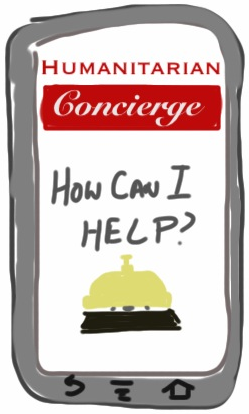
I was recently reading about Sosh’s expansion from San Francisco to New York and it got me to thinking: could we build a Humanitarian Concierge? It would be a crowd-based service bringing together the affected population with the responders where the affected could ask for or look up operational information and get services from fellow affected people or the humanitarian community. It would bring together peer-to-peer needs-response services with humanitarian call centers and digital volunteers.
Of course, Sosh is focusing on your general social life, but why not change the content so that one can look for the closest shelter, request specific assistance, determine the next food delivery, go to the least crowded field hospital, add the next community meeting to your calendar, and find out if your friends/neighbors/colleagues are okay. What I like about Sosh is two fold: 1) they focus on only high quality content (machine algorithms) and 2) before anything goes onto Sosh, it is inspected by a real human to make sure it is legit (human reasoning). These are two of the big differences between Sosh and other personal assistance apps right now.
There are many projects already started that I see would help make such an idea possible. These would include:
- Applications to match needs and resources in an emergency (like Joint.ly, Rynda, and QCRI’s MatchApp);
- Modification of or novel use of existing platforms such as Occupy Sandy’s use of the Amazon Wedding Registry to allow people people to specify their needs;
- Groups of digital humanitarians (perhaps from the Digital Humanitarian Network) to review and curate content;
- MicroTasking tools like those starting on MicroMappers;
- A (local) Humanitarian Call Center that can deal with feedback and perhap route requests through tools like StormPins, Ushahidi, CrowdMap, etc.;
- Check-in/out application for responders and organizations (e.g. Humanitarian ID) so we know who is in-country, what the capacity is to respond, and who can support virtually.
One of the biggest pieces that is missing to making this concept happen is standards. For example, I see more and more of the needs-matching apps showing up, yet there is no data standard behind them. The missing persons applications went through this a few years ago with several different sites and apps. Very quickly the community realized that they needed to come together and build the Person Finder Interchange Format (PFIF). But rather than everyone building their own unique standard, the opportunity that we now have is leveraging the Humanitarian eXchange Language (HXL) project. If each major element (e.g. expression of a need) was to build their standard as a piece of HXL, we could much more easily bring data together in the future. I remember dreaming up the idea with CJ Hendrix a couple years ago and he has really taken the project in a great direction. Now we just need the community to prioritize it, assign resources to it, and start making their data openly available in the HXL format. It will be one key piece to really make the Humanitarian Concierge happen sooner than later.
In regards to the technology, many will see it initially as a smart phone app. But, I see no reason that it could not also be run through SMS. The technology (e.g. RapidSMS and Frontline SMS) already exists and would just be a pipeline into a central response tool which would either respond automatically (if possible) or pass it to the Humanitarian Call Center for attention.
So, what is the Impact of such a tool?
For me, this question is where it could get really interesting. If we have all the data out there and (remote) services to enable people to help themselves and others, we would really be getting at a fully participatory aid-type of response which is defined by Matt Stempeck as being mutual, peer-to-peer aid mediated or powered by information and communication technology. And, we would be delivering humanitarian aid in a networked age. It could become a reality where large humanitarian organizations have to take a different role than they have had in the past decades. Perhaps it becomes more about providing raw supplies to allow for on-demand 3D Humanitarian Printing, providing pre-positioned services like AidBox, and providing assistance to organizations/governments in order to enable them to share their data before & during emergencies.
The traditional donors (governments) would likely have to change how they give their money and the full “donor pool”, including governments, private industry, and individuals, would effectively be recognized together as one group and would have to work together in a networked fashion to help solve problems in near real time.
Digital Humanitarians around the world could truly aid in emergency response. Perhaps they are assisting the Humanitarian Call Center, or helping with manual needs-matching, or translating official documents into local languages, or even driving large advocacy campaigns.
There is no way to know where things are really going. But, we know that change is going to happen. There are already over 1 billion smartphones in use with predictions adding another billion by 2015. One can only imagine that this speed of adoption will continue as smartphone prices continue to drop rapidly. There will be more people out there demanding better, quicker information that let’s them help themselves rather waiting for a food caravan to stop by at some point in the future.
I am curious how we can move this idea forward so please leave your opinions, suggestions and thoughts below in the comments.
Andrej