Humanitarianism in the Age of Context
A couple months ago I had the fortunate pleasure to meet and discuss a few of the challenges we face in the humanitarian coordination world with Rawn Shah and he highly recommended that I read a book that was about to be released by Shel Israel and Robert Scoble entitled Age of Context: Mobile, Sensors, Data and the Future of Privacy. I have since thoroughly enjoyed the book and even had a couple exchanges with Rawn and Shel. The book really makes you think about what the future could hold, how many of the context-enabling pieces that are already present in our world and how the “Internet of Things”, expected to be at 9 billion connections by 2018, will enable the connected human to interact differently with the physical world. We are entering an age where mobile, social media, big data, sensors, and location-based technologies will create the perfect storm for the Age of Context.
Throughout the book, I was pondering how the Age of Context will impact the humanitarian space. There are countless ideas related to aid delivery, affected populations aiding each other, and so on. But, to give you an idea, I decided to focus on how disaster responders deploy and initially respond to a sudden onset humanitarian emergencies. Hopefully this is a generic enough example that a maximum number of people will appreciate the possibilities. The scenario is how responders deploy now and how they could deploy in the future.
Now. Although it will vary by agency, most responders have a quite manual processes for deployment. You are alerted of a potential disaster (e.g. GDACS) which may or may not give an indication of the severity and then you may check news online or with known colleagues though email, Skype or discussion boards. Once you have an indication if you have to deploy, you begin the “deployment scramble”. You dig out your deployment bag and figure out what you are missing, download the emergency briefing kit from ReliefWeb, hunt for your passport(s) and related paperwork, search Wikipedia and CIA fact book for background information, frantically deal with the travel agents about flights, guess at the most appropriate clothes to wear, and spend a few rapidly passing minutes with our family. Somehow you get to the airport, stand through lines and maybe read a few printouts that someone gave you. On the plane you either try to read as much as you can or you sleep knowing that you won’t sleep much after arriving. Once on the ground, you spend 1-2 hours dealing with customs about your visa. When you get through you might be lucky and find a reception center at the airport that tells you where the coordination center is and how you can join a contact list. Unfortunately your luggage has not arrived so you spend 30 minutes putting in a claim. You are connected to an organization with an office in-country meaning that there could be transport to some kind of office…..but, if not, you have to take a taxi, cross your fingers and hope to arrive safely. Now, you get to work. Which organizations are responding in-country that you need to know about? How do you find the people leading sector responses (e.g. Health, Food Security, etc)? Where will the next coordination meetings be? Who do you know in this emergency that you have worked with before? Where do you sleep tonight? These are just a few of the decisions that responders need to make and they all seem to be made in a state of scramble. End of day one and you are exhausted having just sorted out the basic details. Tomorrow starts in 4 hours.
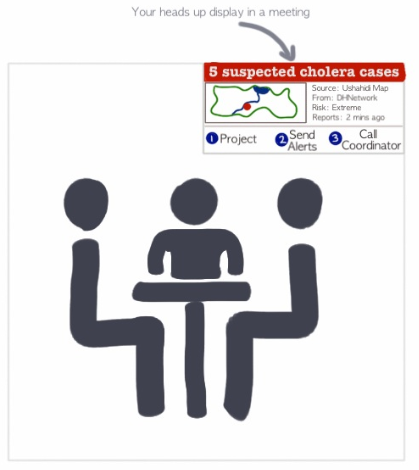
Some time in the future. How could this same scenario change with a bit of context? You are alerted on your smart phone (or wearable device like Google Glass if you have one) that a major disaster has occurred. Since there are countless sensors present in the world, including on phones and wearables, the scale of the disaster is almost instantaneously gauged. It is big and you know that you are deploying. So does your team, family and in-country colleagues. Your Personal Context Assistant (PCA) immediately checks you into the emergency, based on a quick confirmation with you, using the Humanitairan ID (HID) system. Your PCA then tells you how many minutes away your deployment bag is and how to get there with pin-point accuracy. It also tells you what you need to replenish in the bag and the closest store to pick up the items [as the PCA can order them for you]. Since it knows the weather forecast, you are presented with recommendations of which clothes you should consider packing. Given that your family has been alerted, they are all on their way home so that you can spend some time together. Your travel agent was alerted so your flight has been booked and your PCA has made arrangements for your pickup (taxi, car share, etc). You are assigned a luxury car because all data from past rides, chronicled in the cars’ Event Data Recorders, show that you are great customer. Projects like OCHA’s Humanitarian Data project and the Decision Makers’ Needs community have made data easily available and common questions are already answered. Everything is synced onto your Humanitarian Kiosk mobile application in case you are ever without Internet. On your way to the airport, your PCA informs you that the sector-specific coordinators have been added to your contact favorites, that the relevant coordination meetings have been sync-ed to your calendar from HumanitarianResponse.info, and that several colleagues you know from past emergencies are on their way. You are also presented with a list of hotels recommended by your in-country colleagues and you select one. At the airport, you review all the data you have been presented (as it is in a simple Q&A format). You make several calls to other responders and the Digital Humanitarian Network to formulate a plan on how to enable or support a participatory aid market place that your PCA notified you about. You speak to your family before you are called to board the plane. While queuing, you spend 5-10 minutes tagging images using the MicroMappers app to help identify damaged infrastructure. In the plane, your in-seat display connects with your PCA and you can continue working as the flight is Internet enabled. You are notified that several other disaster responders are on the plane so you hold an ad-hoc meeting at the back. Later on, your PCA recognizes that you have not slept for 20 hours and suggests that you should get some sleep before arriving. You agree and your space is dimmed to your personal tastes. You wake up somewhat refreshed when you land. Upon entering the airport, your humanitarian ring is scanned and you are immediately recognized as a disaster responder so customs rushes you through directly to a car reserved by your PCA. Your luggage has not arrived, but your PCA knows exactly where it is (since you use a service like Trakdot) and has already put in a claim noting your hotel details. The car is driver-less but with the chaos in the capital, determined by sensors, the car company has provided you with a driver today. She knows exactly where you need to go - to a critical planning meeting - and can take you the optimal way by leveraging current traffic patterns and MicroMappers infrastructure damage reports. In the meeting, everyone is well informed so details are reviewed and decisions are made. You then have a group call with past responders that you know and get an idea of what they are learning. You decide to meet in person to discuss the details. Your PCAs arrange a meeting for the group based on all of your locations and travel time. One of them does not have a car so you authorize specific use of a share-enabled car in her neighborhood. It is noon and your PCA informs you that, with the time difference, your kids are going to bed soon. So, you quickly initiate a call with them to chat about their day and your experiences. You tell your PCA to order your spouse his/her favorite flowers or chocolates to arrive the next morning. You have dinner with sector-specialists including the government to discuss the overall needs. During the dinner, you are all alerted of a potential cholera outbreak in a remote village by new social media reports showing up on a Ushahidi-powered crisis map. Your PCA recommends a set of context-specific messages (from the CDAC Network Message Library) that you confirm before its sends out through SMS, email, smartphone notification and radio to the local population within a certain radius of the initial reports. Urgent SMSs are also sent to responders in the area in order to prepare for a possible response. With access to anonymized telecom data, your PCA analyzes neighboring communities where people might move to based on past holiday movement patterns. Responders in those locations are also warned. The World Health Organization in Geneva is alerted and they add the information into their disaster response center. You have enabled pin-point humanitarian response. This will not be another Haiti cholera outbreak. In the same discussion with the government, you had also agreed to setup a Kickstarter-like fund for the emergency. Your PCA had immediately sent an urgent message to your private-sector partners in Silicon Valley to get the fund setup. You are informed before the end of dinner that it will be ready in the morning and that a major marketing firm will spread the details world-wide over the next two weeks. Your day proceeds relatively smoothly as you are very well informed, your schedule has remained manageable and your PCA kept you safe. Your movements have always been safe because your PCA is connected to the UN Security Department thereby receiving all of the latest information. And if needed, your movements can be securely monitored by the UN security department and your family since you leverage apps like Glympse. At 10:30PM, you are back in your hotel where you do a little exercise, use SmartThings to unlock your home front door for your spouse who forgot her Google Glasses when leaving for work, and go to bed at 11PM. Tomorrow starts in 7 hours, but you have already accomplished more in one day than used to take one week.
Emergency response willbe different in the Age of Context.
Security will become even more paramount in the future than it is today. This comes in three elements: 1) security related to delivering aid, 2) security of responders, and 3) security of the affected population. As devices spread in humanitarian emergenices, I suspect that we could see a time where context really helps us to better deliver in insecure environments. Schreter and Harmer point out that “active acceptance-based approaches are considered more successful in providing assistance to beneficiaries than approaches that rely on heavy protection – so-called ‘bunkerisation’”. And, context could make active acceptance-based approaches much more safe to implement. Ensuring responder safety will be a combination of personal awareness, organizations building trustworthy services, and central security services opening-up how they share safety alerts. However, it is the security of the affected that we will need to consider the most. How will data be used that is collected on someone who is given food? Someone living in a refugee camp? Or someone who is given a dissolvable tattoo that monitors their bodily functions for a set period? In a conversation with Robert Klitzman a couple years ago, he raised the topic of bio-related ethics and how are we going deal with data that relates to our health. Would data collected by health care professionals during an emergency possibly affect the person’s future insurability or ability to find employment? Who gets access to this data especially if it was “given” when the person was in a vulnerable state? These are hard questions and will need to be answered.
Although some of the pieces that I have mentioned seem futuristic, it is quite surprising how many of these could become a reality very soon. Humanitarian ID, the Data Project, and the Message Library are all in development. Platforms like Ushahidi are already established and would only need a little customization. Others pieces like “sensors everywhere” are a bit further way. I suspect context features and services for the affected population will come later unless we give everyone smart phones and amazing apps. But, for whomever a contextual service is targeted, it will be the “little data” that we can find inside the intimidating big data that everyone talks about. We need to find the diamond in the coalmine or the needle in the haystack to make things constantly contextual.
Based on what happened in the future scenario that I outlined, one might ask about the role of the humanitarian organizations and of the private sector. It is clear that most of these features will likely be enabled by the private sector so they need to become a much more critical partner in future emergencies. But, what is the role for humanitarians? Although the Secretary-General of IFRC questions the possibilities of arm-chair responders by citing the 2013 World Disaster Report, it will be the humanitarian organizations that not only ensure that we upload the Humanitarian Principles and Values, but the ones that people will come to trust. As Israel and Scoble point out, it will be the most trustworthy entities that thrive in the Age of Context. “Transparency and trustworthiness will be the differentiating factors” and “the most transparent companies—the ones that give the user privacy options they can understand and the option to turn apps and devices off and on as they see fit—will be deemed the most trustworthy. Similarly, companies whose products warn users before they do something that might embarrass them will be valued and trusted, gaining the customers’ loyalty along the way.”
Both humanitarian organizations and private sector companies (who want to help) will need to transform themselves, in every way, to become trustworthy entities. It will be the ones that do who survive.
Andrej