A Powered, Future Information Center?
In the past UN-OCHA would established a humanitarian common service called the Humanitarian Information Centre (HIC) aimed at servicing both the national and international responding community with data, information, and product services. Those days are behind us, but I wanted to ponder the idea of an information center aimed at serving the affected community in the early days of an emergency.
In recent years, the idea of effectively communicating two ways with the affected population has really taken off largely as a result of the promise that modern technology could make it happen. Still, the focus has often remained with sharing information out to the community as the puzzle of receiving (i.e. crowdsourcing) and actioning information from the community has not yet been solved. So, what if the humanitarian community setup a multitute of information centers throughout a disaster zone? Such features often exist inside an evacuation center or camp, but I am thinking well outside those “boxes”.
Having a distributed set of networked centers, would allow responders to collect information in a structured way as people visit (think standard forms), to give our technology as aid (see When Will Smartphones be Aid?), and to provide a wide range of services aimed at benefiting the community.
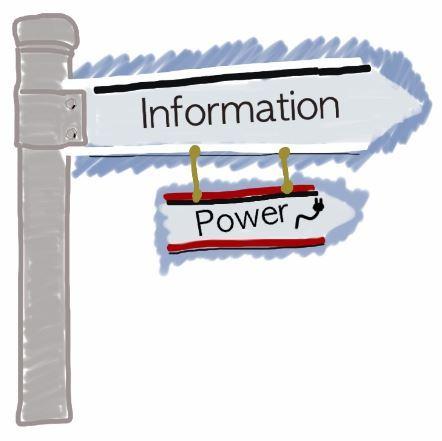
The power challenge. With our growing dependence on technology, the availability of power to charge even the basic devices like a feature phone becomes a challenge. Many affected populations have found creative solutions ranging from hacking car batteries, to pay-for-charge generators, to daisy-wheeling power cables from one power source, to mobile companies offering free charging stations. But, the question that always came to my mind was how can we scale such solutions and make them predictable for future emergencies. Recently, Aimee Wielechowski, a former OCHA colleague, introduced me to Volt and my optimism greatly increased.
One of the things that I like about Volt is that they are a new company (2011) and are looking at the Mobile Recharging experience differently than others that I have come across. Rent, Charge & Exchange. Although their current focus is providing a recharging service for smartphones at festivals and similar events where traditional power sources are not easily accessible for longer periods of time, I think that they may be onto a model suitable in disasters. For those who have been in a sudden onset emergency, does “traditional power sources are not easily accessible for longer periods of time” sound familiar? To learn more specifically about Volt, check out their introductory video. The great news is that apparently Volt is starting to explore how their approach could be used in emergencies.
Of course, I believe that such a service would need to be married with other power solutions. For example, LG gave solar panels to help power major evacuation centers in response to Typhoon Haiyan. Imagine an emergency where the responding community provide distributed Volt-like services with LG-enabled solar farms in central locations.
Bringing power to the affected community will result in both the obvious and the not-so obvious. Most importanntly, it will enable information exchange both ways. People will want to come to the center for their power needs while staff can query for structured information. The visitors can ask for information - about missing persons, aid distributions, security, employment opportunities, etc. By providing a service that the affected want (and can come when they want), we can collect more structured input from the community than we have ever before. And, being structured, such data enables us to do much more analysis and enable more decisions than ever before.
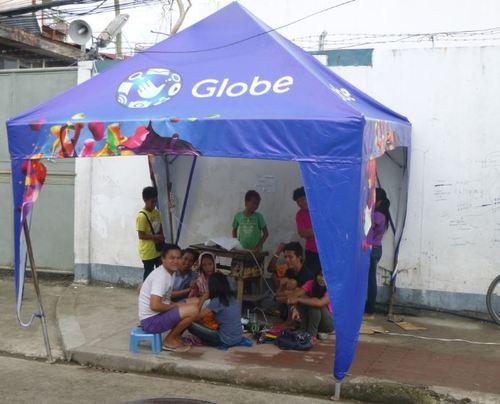
These centres would not have to be fancy or elaborate places. They would not have to be expensive. They could be centrally supplied and serviced so that outposts could be quite simple. Not a lot more than the Globe charging stations deployed in the Philippines to Typhoon Haiyan. They could become the focal points who liaise with the Digital Humanitairan Network thus enabling remote volunteers to more directly help those in need (find services, translate UN materials to local languages, connect with family abroad, etc). In areas with specific needs, specialized staff could be present to help answer unique questions or demands. They would become a real, on-demand service center for the affected. And, if managed correctly, they would enable the responding community to have their “finger on the pulse” at all times.
The one question some will ask is about security. How do we make these centres safe for staff. For those in the UN-like world, it will probably seem an unsurmountable problem. But, what if we take a different approach? What if we define the model and then open-source it for anyone to implement? The model would include details on the minimum product & services to provide and the necessary agreements (tools to use, security of personal data, sharing of structured data with central body, etc). This approach would get around the UN-security restrictions as it would allow almost anyone to run an outpost center. It could be a small international NGO, a large natioanl NGO, a university, a mayor’s office or a chambre of commerce. In an insecure environment, it could be run by a group who are considered secure in the environment.
The key to such a solution will be defining the model, finding a way to open-source it, and developing key predictable partnerships. As I have said before, it will be Partnerships + Emergencies = Innovation. The big question from me is how many more emergencies will we see before such a solution is put in place?
Anybody keen to get started?
Andrej
Update: on 15-April-2014 as part of another project, I read the CDAC Network Update #5 on Typhoon Haiyan where First Response Radio (FRR) “reported that a lot of people are listening to the radio on mobile phones, and also that charging stations and aid distribution points would be a good place for information provision”