Guidance for Establishing an Affected Persons Information Center
Fresh off my return from responding to Typhoon Haiyan in the Philippines, I reflected on the challenge of getting information to and from the affected population. Collecting information aligns with my day job in such emergencies. However, I see that we keep falling into the same trap of focusing solely on what we need and quickly de-prioritizing the information needs of the affected population.
The importance of information for the affected population has been raised several times over the years. Imogen Wall authored Left in the Dark? in 2008 and Still Left in the Dark? in 2012. Internews studied the Dadaab camp in 2011 [PDF] and released similar findings. And, just last week, Internews shared an inter-agency study on Iraq* [PDF] that pointed to the serious lack of information accessible to the affected population.
Since the 2004 tsunami, I have seen a lot of great work being done by organizations like Internews, networks like the Communicating with Disaster Affected Communities network (CDAN), groups like Communicating with Communities (CwC), and volunteer entities like Translators Without Borders. I saw some of the efforts and benefits myself in Guiuan. But, if new reports are being released that still note the lack of information problem, are we open to trying something new?
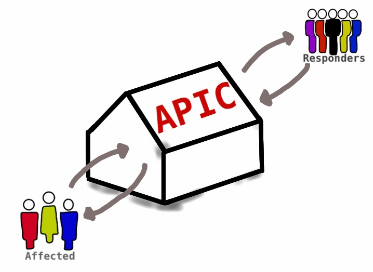
In May, I was joined by Viktoria Lovrics to look at the possibilities of someone establishing publicly-accessible information centers during a crisis – something I had earlier referred to as a powered, future information center. Could someone provide core information, directions on how to get more help, as well as services like mobile phone charging and Internet access? If so, could we – at the same place and time – collect structured information from these visitors? Such a structured collection would be a novelty when you consider that a lot of effort is currently going to mining unstructured social media, SMS messages, images, and other large data sources. So, not only would we benefit the affected population, but we could get better data that we could analyze much faster.
As suggested in my previous post, Viktoria and I wanted to create something “open” that could be used by anyone – a large international organization, a small NGO, a government agency, a community leader or simply a group of volunteers.
Today, we are excited to release Guidance of Establishing an Affected Persons Information Center [12 MB]. For 2 page summary, see the APIC Brief. The guidance is broken into three parts:
- Understanding Affected Persons Information Centers (APIC),
- Identifying and Addressing Limitations, and
- Guidance for Construction of and APIC.
Characteristics and features of an APIC could include:
- provision of a publicly accessible physical space committed to information broadcasting and collection,
- co-run by representative from affected population as well as from humanitarian responders (with knowledge of local language),
- visible bulletin boards (including text and visuals) with relevant and updated information,
- access to electrical power for the purpose of charging devices such as mobile phones, tablets, and laptops (from renewable and simplistic technologies),
- provision of telephone and Internet services in partnership with local Mobile Network Operators (MNOs),
- a staffed Humanitarian Concierge that provides, and has access to, emergency services (such as hospitals, psycho-social hotlines, a humanitarian call center),
- education and guidance on various technologies used to facilitate aid and continue communication such as Freedom Fone and Twitmobile,
- a social media presence, where such capacity exists, in order to share information and dispel rumours regarding the response,
- advice to the affected population and responders regarding shifting security concerns or situations, and/or
- a mobile APIC, where the capacity and need exists, that can access smaller and remote communities.
Considerations for topics like security, staffing, which information to share, methods of communication, and so forth are all addressed in the guidance.
We hope that you find the guidance beneficial should you decide to set-up such a center in a crisis to better inform the affected population and to enable a better response.
Andrej
Update: directly after posting my blog, I opened a Communicating-with-Communities newsletter which linked out to material by world vision about setting up Help Desks at distribution points, establishing open Feedback mechanisms, and being Transparent by providing information to the community.
Note: although I am an employee of UN-OCHA, this guidance is not a product of and does not reflect any ongoing or planned projects of UN-OCHA.
* The inter-agency report was conducted by Internews, UN-OCHA, World Vision, IOM and the Norwegian Refugee Council (NRC) with funding from the World Food Programme.