5 Cues and Tough Decisions
About a month ago a couple of my colleagues attending the ISCRAM 2014 Conference – an international conference on information systems for crisis response and management – reached out to me during one of the sessions. They informed me that the digital humanitarian attendees were asking for proof that the digital humanitarian responders had direct impact on decision makers during the emergency response in the Philippines in the aftermath of Typhoon Haiyan. I found this request difficult to answer. Here is why:
Over the past 10 years, I have seen OCHA and the humanitarian community create many products. Unfortunately, due to budget constraints, humanitarian organizations do not usually have the capacity to follow each product sufficiently to gauge their effect. This is one of the hindrances within the community in measuring a product’s impact. A second hindrance is that there is no identical parallel emergency not using the product for comparison purposes. The set of circumstances in each emergency is different. Thirdly all of the products, systems and organizations work together to produce an emergency response. It is difficult to measure one product in isolation.
In the Philippines, the Digital Humanitarian Network provided OCHA with 40% of the data for our first 3W (Who’s doing What Where) product [PDF]. Fortunately, I was able to put the 3W and other volunteer-developed products directly into the hands of the UN’s most senior humanitarian official, Valerie Amos, and spend a few seconds explaining them before she went into meetings and interviews. This opportunity is extremely rare. Most often, due to nature and circumstances of emergency response, an IMO (Information Management Officer) is not present when such a product is distributed.
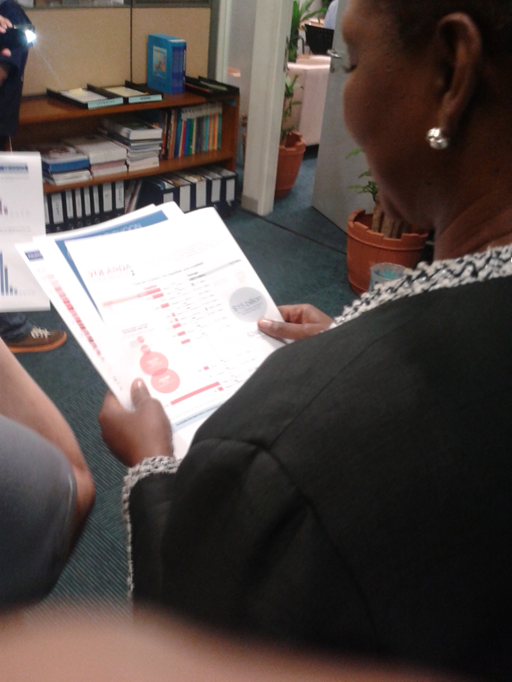
I cannot know the exact impact that the 3W product had when it was handed out at donor meetings, distributed in inter-cluster coordination meetings, and shared to over 2,000 people on a mailing list. I can only believe that its use greatly contributed to the humanitarian response. It augmented our other products and arguably helped to paint a more complete picture for a range of decision makers. Providing proof that this was the case was not something we sought to measure. It seemed obvious.
However, in discussing with colleagues how to respond to the digital humanitarians’ request, I recalled something that I had read in Gary Klein’s Streetlights and Shadows: Searching for the Keys to Adaptive Decision Making about pieces of information required to make a decision. After digging through my notes, I found what I was looking for: the author argues that experts typically use 5 cues to make a decision.

Even though only 5 cues will matter, experts tend to ask for more data than they will use. In an emergency, it is a constant stream of information from which decision makers need to take action. Experience helps responders develop patterns that let them size up situations quickly and accurately, therefore enabling them to judge what to pay attention to and what to ignore. They reserve their attention for the most important cues and aspects of a situation.
At the same time, we know that people can usually only hold 2 or 3 things in their short-term memory, meaning there is only a small chance that a given decision maker will be able to give you post-facto feedback on your product if they choose to ignore it in the stream of other cues. And, in a recently commissioned learning report by ACAPS entitled The Use of Evidence in Humanitarian Decision Making [PDF], the authors noted that “current processes of decision making tend to be undocumented and un-transparent. It is therefore hard to judge whether or how information and evidence have been used to inform them” while also noting that it is “common for experienced staff to base decisions mainly on past experiences, instinct, and assumptions – even in the face of contradicting evidence.” The result is that it is unfeasible to measure the impact of one specific product. There is a lot of information available, different experience has framed it differently for different decision makers, and it is impossible to ever know which combination of cues each decision maker used or ignored.
What is a cue exactly? For me, it is a range: from map products like the 3W, to verbal discussions with colleagues, to visual signs in the environment, to experience in past emergencies, to situation reports from different organizations, to assessments taken across the emergency, to political pressure from various governments. The challenge is how to figure out what cues are important to decision makers during emergencies and then focus our data and information efforts to this end.
Although there has been tons of research into decision making outside the humanitarian sector, the field of study is in no way complete or conclusive. The limited resources of humanitarian organizations to put towards studying decision-making (when compared to private industry), make understanding its intricacies even more difficult.
However, some work has started.
- AidData has started testing the hypothesis that maps help make decisions [PDF]. In their first pilot study they found that appropriate maps influence better decisions in the distribution of aid funds.
- The Digital Humanitarian Network Decision Makers Needs Community of Interest held a workshop on Field-Based Decision Makers’ Information Needs in Sudden Onset Disasters in September 2012.
- The Disaster Resilience Lab spent 3 weeks in the Philippines during the Haiyan response analysing information flow, decision making and the impact of digital volunteers. They wrapped up in December 2013 and have not yet issued a public report. To me, this delay gives an indication of how difficult the problem is. However, it does not mean that we should give up. Rather, I see this challenge as one of those “hard ones” that we have to challenging ourselves to solve.
As difficult it is to answer their question, I am glad that the digital humanitarians are asking these hard questions. We need as many catalysts as we can get to help us find ways to understand decision-making and to make decision-making during emergency response more effective. Those affected by disasters depend on it.
Andrej