HXL Version 1.0 goes live - #awesome
I still remember the conversation as if it were yesterday – sitting with CJ Hendrix in our office in Geneva in 2011 talking about data standards and the need for some kind of humanitarian XML solution to help let data flow more easily between responding actors. Others had tried building new systems, but no one in the humanitarian sector had tried focusing on exchange between existing systems. I could see CJ’s eyes lighting up with excitement at the possibility. He was passionate about data standards and was itching to “do something”. We had to try. Why waste more time talking when we could be doing? Let’s build a Humanitarian Exchange Language (HXL)!
Although management was supportive, we did not have the financial resources to build large working groups or hold collaborative meetings. We had to find passionate collaborators who wanted work with us on a proof-of-concept. In November, CJ met Carsten Kessler at the International Conference of Crisis Mappers in Geneva and a passionate data standards collaborator had been found.
Working with a couple of key partners, CJ and Carsten began defining what HXL would become. Over the coming few months, the team defined an RDF-based* exchange language around specific humanitarian topics. Although leading edge, there was a concern that RDF would be too much for the humanitarian sector. Yes, big players like Google, Microsoft, and Wikipedia were already using such standards. But, perhaps we were not ready for it (yet).
Because of that concern, OCHA backed away from the RDF-based HXL concept. Fast forward a bit and a forward-looking Humanitarian Data Exchange (HDX) team picked up HXL with financial support from the Humanitarian Innovation Fund. This time, OCHA knew that a simpler approach was needed.
Enter David Megginson to lead the project. In the early days, the newly formed HXL Working Group stumbled on a seemly simple, but genius idea. Why don’t we use the hashtags (#) approach? With wide adoption on platforms like Twitter, the concept and use was well understood. We would define a set of standard tags and attributes. We would keep HXL simple to start thereby reducing the barriers-to-entry for any organization wanting to adopt it. HXL would be simple enough to work in the lowest common denominator - Microsoft Excel - by simply adding a row to any sheet. It could be added to a database or API with minimal effort. It would be a start of something that we could build on.
So, today is an amazing day as Version 1.0 of HXL is going live.
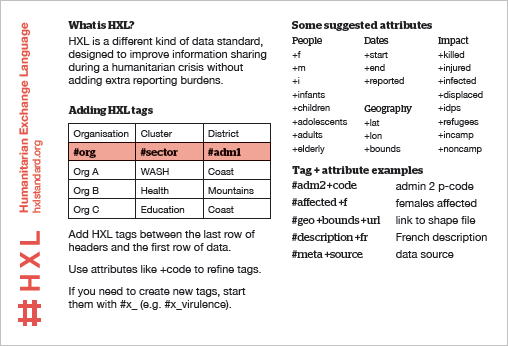 [
You might be wondering, what can HXL really do? To answer that, I suggest reading a recent post by Simon Johnson about what is possible when an organization, like the British Red Cross, adopts HXL [PDF]. And, that is just the beginning. In parallel to the standard, David has been working on a set of open-source data cleaning and processing tools for HXL-ated data. You may want to check these out at http://proxy.hxlstandard.org.
Although they may not accept much credit, there are many who have helped get us to HXL Version 1.0. CJ and Carsten were pioneering within a rather risk-averse sector. Andrew Alspach supported them from the beginning. Conferences like ICCM made connections possible. OCHA management did not punish anyone when the proof-of-concept did not succeed, but rather supported us learning and trying again. Sarah Telford, HDX’s manager, had the foresight to pick up the project and give it another chance. The ICT4Peace Foundation was an early supporter of HXL, arranging consultations with other UN offices and technical experts. The members of the HXL Working and Governance Group members - Andrew Alspach (UN-OCHA), Albert Gembara (USAID), Gavin Adam Wood (UNICEF), Genevieve Wills (WFP), Ivan Vukovic (IOM), John Adams (DFID), John Crowley (formerly World Bank), Jus MacKinnon (Standby Volunteer Task Force), Lauren Burns (Education Cluster), Laurent Pitoiset (UNHCR), Maurizio Blasilli (WFP), Muhammad Rizki (WFP), Paul Currion (Humanitarian Innovation Fund), Sara-Jayne Terp (ThoughtWorks), Simone Alzari (WFP), Simon Johnson (British Red Cross), and Tassilo Teppert (WFP) all helped to shape and to advocate for the project. Patrick Hernusi, though he doesn’t remember it, gave HXL it’s name.
And, of course, a rather special “kudos” to David Megginson – the man who did all the heavy lifting to make it happen. He somehow managed to both discuss and to do something. My hat goes off to you David.
For more details on the history and development of HXL, I suggest that you read ALNAP’s recent report Standardising humanitarian data for a better response: The Humanitarian eXchange Language [PDF]
Andrej
* According to Wikipedia, RDF is a family of World Wide Web Consortium (W3C) specifications[1] originally designed as a metadata data model. It has come to be used as a general method for conceptual description or modeling of information that is implemented in web resources, using a variety of syntax notations and data serialization formats.