Yes, failure happens
Okay, let’s admit it. We have all been involved with projects or activities that failed. Yet, few of us are willing to admit failure or to talk about these failures – at least publicly or in a useful level of detail. I am going to admit right now that I have been involved with projects, in a variety of roles, that failed. Some big. Some small. Sometimes in the supporting cast. Sometimes in a leading role. There I said it.
Failure is important. It helps you develop first hand knowledge that can be used to avoid failure in the future. It help you gain experience thus altering your state-of-mind and future approach. It helps to make you resilient and set realistic goals. It improves your chances of succeeding going forward. For something that is so valuable, it is unfortunate that we do not spend much time talking and reflecting on the experience.
A few years ago, I became inspired about the idea of opening up about failure after reading official Failure Reports from renowned organizations like Medecins San Frontiere (Doctors Without Borders). If they could write public reports about their failures and, perhaps most importantly, what they have learned and how they have adapted, why couldn’t we?
Last year I was joined by Nikita Bhide and we decided to investigate failure in Humanitarian Information Management (H.IM). We were not sure what we would accomplish. We knew that not everyone likes to share their failures. Nikita spent time hunting for documented cases of H.IM failure only to come up mostly empty-handed with the exception of large after-action reviews that made general comments about H.IM in emergencies. Themes became apparent across these reports thereby helping to structure our next step.
We then put together a simple, anonymous survey to ask people for their stories. We asked questions such as: What were their main causes of failure? What were the main blockers to H.IM project success? How did they personally deal with failure, and how did their organization handle it? We shared the survey amongst many public forums and social media. Then Roxanne Moore spent significant time statistically analyzing the responses and reviewing the narrative comments provided.
Today, we are excited to share the H.IM Failure Survey Report – Why Do They Happen and How To Address Them. The report outlines general causes of H.IM failure, how individuals deal with failure and how organizations respond to failure.
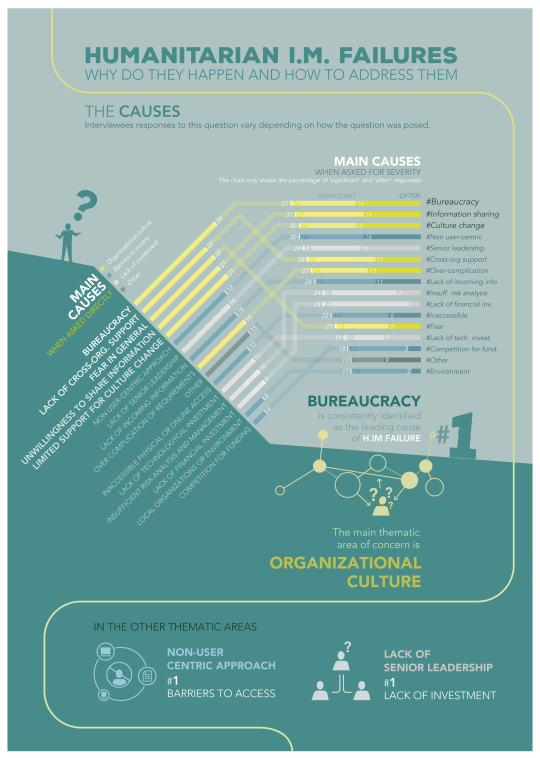 [Download report - PDF | A2 Poster]
When you read the report, there is a high chance that you will not be shocked. It will likely seem logical and obvious. It may confirm what many of you already believed to be true. But, by confirming these beliefs, we can start moving forward, addressing the main causes of failure and learning from our mistakes.
In Amy Wilkinson’s recent interview on the Curious Mind podcast for her new book, The Creator’s Code, she mentioned that some successful entrepreneurs estimate that at least 1 of 3 projects will fail. That is a significant percentage, but a percentage that I believe is almost overly optimistic for the humanitarian information management discipline given the challenging and political space in which we operate. Perhaps we should be looking to the the private industry where angel investors only expect one in ten technology projects to be successful. Either way, we are talking about a failure rate that we as an entire sector – especially donors and senior management – need to become comfortable with.
Kudos to Ignacio G Robello for amazing design work once again.
Andrej