I scramble. You scramble. We all scramble for data!
When disaster strikes, responders, especially information managers, go looking for data. These responders – of which there are countless across the humanitarian organizations – are most often looking for the same data sets. But, until recently they had little to no coordination. A massive duplication existed and continued to persist well into the digital age. Tools for online coordination were available but underused.
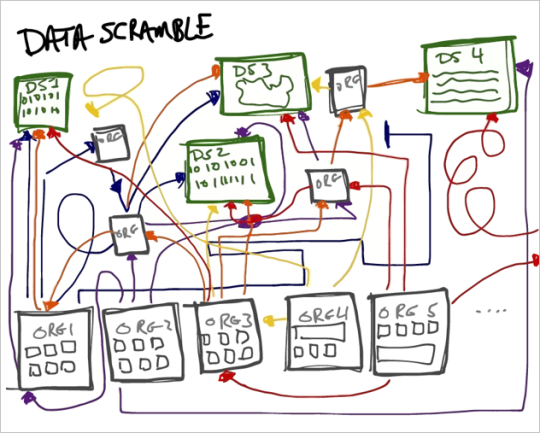 During the 2011 OCHA Lessons Learned workshop after the crises in Libya and Japan, participants identified a clear need for coordinated data scrambles. If, by their nature, sudden onset emergencies were going to precipitate scrambling for data, it was becoming increasingly obvious that technological platforms (eg. Skype, Google Docs, etc.) would really aid communication and save everyone a bunch of time.
The need for such coordination became abundantly clear when, shortly thereafter, the Horn of Africa situation deteriorated significantly. I was visiting the World Bank at the time and their geographic information system (GIS) team was looking for a specific dataset. One team member noted that his friend at the U.S. State Department might have a contact at the U.S. Embassy in Nairobi…who might have a contact in the Government. What they did not know was that the data they were looking for was, in fact, a Common Operational Dataset (COD). I put them in direct contact with the OCHA IM Officer who managed the CODs. [Later we put the CODs onto HumanitarianResponse.info and recently migrated them to the Humanitarian Data Exchange (HDX).]
I happened to be a right place at the right time to help the team at the World Bank. But what about everyone else – across all the different responding agencies – who could benefit from being pointed in the right direction when looking for the data that they needed? So, we quickly setup a Skype group for the Horn of Africa response and started inviting anyone who we thought might be interested.
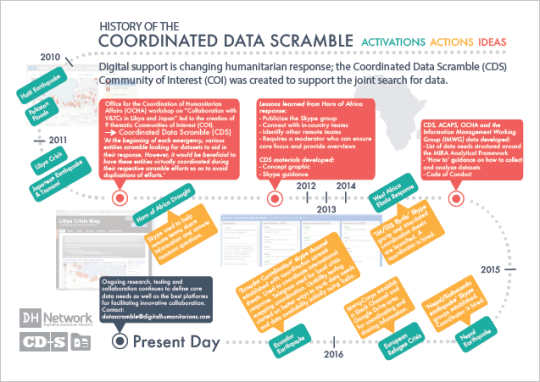
That is where the Coordinated Data Scramble (CDS) comes into play. Over the past five years we have organized several data scrambles. These scrambles initially took the form of Skype groups during the crisis in the Horn of Africa in 2011 and have recently taken the shape in Slack during the EU Refugee crisis and Telegram during for the Ecuador earthquake. Some of these scrambles have grown to over 700 members. Generally, these efforts are paired with other collaborative tools like Google Docs and Trello.
Below is a timeline graphic (by Iram Partap) that show how the community involved in CDSs has evolved over the past few years.
Major credit has to go out to Helen Campbell who has been driving the community forward the past few years and, of course, the various coordinators who have helped online coordination. Together they have been making a big difference. And, now, with HDX becoming the platform to share data, we are in a much better place than 5 years ago to greatly reduce the redundancy seen when everyone scrambled alone.
To collaborative and coordinated innovation!
Andrej
P.S. To get in touch with the Data Scramble folks, reach out at datascramble@digitalhumanitarians.com