Blockchain for the Humanitarian Sector - Future Opportunities
A couple years ago, I wrote about the possibilities of a digital currency in humanitarian response and have since followed others, like Paul Currion, who did much more in depth research and conceptualization (e.g. AidCoin). A few months later, I was pondering how to entice people or organization to be more open with their data. Shortly afterwards, I started asking myself: “Could the technology behind BitCoin, called blockchain, be used to help free humanitarian data?” Often times, large organizations, especially governments, do not want to share their data in fear that it will be used in for-profit purposes. Could we we use blockchain to provide an environment where such organizations would feel comfortable with sharing? I had no idea as I did not understand the technology.
Earlier this year, I was joined by Vanessa Ko to whom I addressed that very question. After several months of research and great conversations with the likes of Alex Tapscott (BlockChain Revolution book), Trent McConaghy (Ascribe.io and BigChainDB), Paul Currion (Start Network), Lilian Barajas, Andrew Billo, Juliet Lang, Sophie Tholstrup and Roxanne Moore (OCHA), Mike Fabrikant (UNICEF), Lily Frey (ELAN and CaLP), Steve Ehrlich and Nick Vani (Spitzberg Partners), Sarah Martin (Digital Currency Council), Paul Currion (Start Network) and Brett Scott, Vanessa and I are happy to finally release our Digital Humanitarian Network paper: Blockchain for the Humanitarian Sector - Future Opportunities
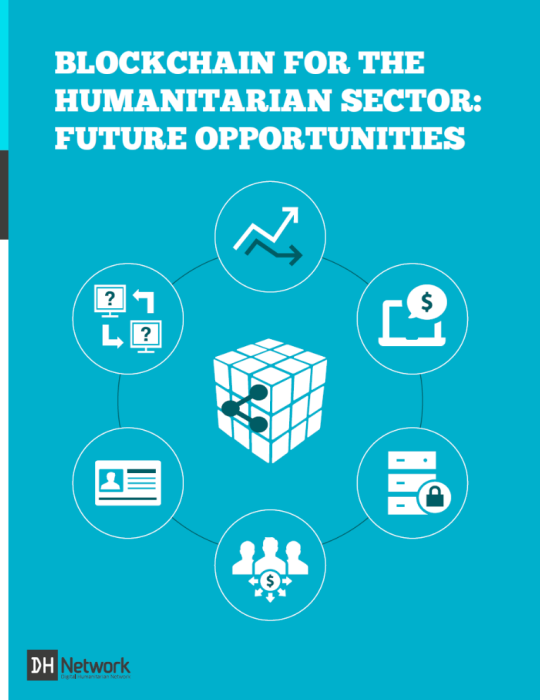 [
In the end, we did not restrict ourselves to the data sharing question. Rather we explored the blockchain technology itself, outlined benefits and challenges, and then discussed six areas within the humanitarian sector it could be applied. They are:
- Protected Data Sharing (the question I originally posed to Vanessa)
- Identity
- Supply Chain
- Donor Financing
- Cash Programming
- CrowdFunding and Microfinancing
As blockchain technology continues to gain momentum across sectors, the humanitarian community can look to this new technology to help address ongoing challenges. The technology alone cannot solve fundamental issues within the sector, but it can offer new insights and provide a new tool for solving some of these challenges. Further research and development are necessary into which applications and use cases are most appropriate for the blockchain, and careful consideration of the benefits, impacts, risks and required resources must be taken into account.
Andrej