Using Facebook, SurveyMonkey in disaster response for (direct) survey of needs
Just over one year ago, an OCHA colleague – Chris Hyslop – reached out to me with a relatively straight forward question which neither of us could easily answer. The OCHA Myanmar office wanted to know, with the increasing penetration of mobile phones and social networks in-country, could the affected population provide information on needs directly to the humanitarian community immediately after an emergency? Could they leverage technology such that the results were received immediately, not require any responder to be physically deployed and be truly representative of the needs? Could the information be received in a structured manner (versus using artificial intelligence and volunteers to scan something like Twitter)? Would the results help guide the early days of an emergency before the more-encompassing, in-person needs assessment was completed?
Recognizing that such a ‘free-flowing channel’ proposition could create endless debates, we reached out to a few key contacts to gather ideas and get feedback on how to build a minimal survey (while remaining statistically valid). Once the survey was ready, the questions became: how do we build it and how do we share it with only those in the affected area? This point is where things got interesting for me.
Bucking the trend of ‘let’s build ourselves a new tool’, the OCHA Myanmar team began testing several survey tools and investigating how to geographically target people on social media. The resulting solution was a combination of Survey Monkey and Facebook Ads. Why Survey Monkey? Because it supports the various Burmese scripts that are needed and because it provides details on where the person is physically placed during submission, thereby allowing statisticians to easily discard irrelevant submissions. Why Facebook Ads? The answer is two-fold. First, it allows for very localized targeting. The second, and perhaps more important, reason is that Facebook has a special role in Myanmar – it is not a social media, but rather it is the internet to many people. They use Facebook as their entry point to the internet meaning that it is the major channel of communication to/from the general public in-country. The result was a fantastic example of leveraging available technology instead of building a custom solution for a humanitarian response.
It was not long before the office had their first test – Rakhine State floods in 2016. Results were positive and lined up with the official government findings that were compiled from local authorities over the coming days.
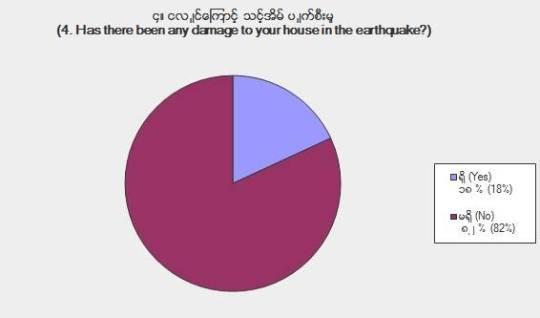
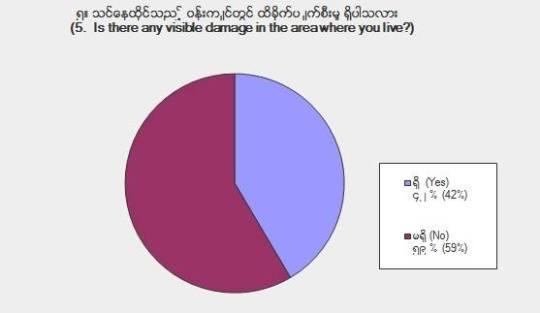
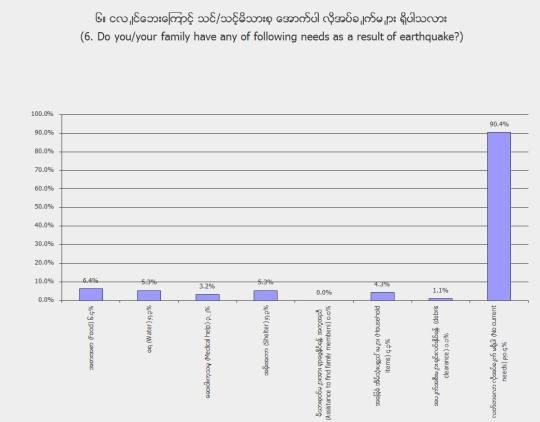
In March this year, Myanmar was hit by an earthquake and the approach was called into action again. The survey targeted general public in the three most affected regions. As soon as the survey was ready, they boosted it, as a Facebook ad, targeting the age group between 13 and 65 within 20 kilometers of the epicenter. They spent about US$50 to run the ad for a day. It reached 22,558 people with 1,679 engagement to the post. Almost 690 people clicked the survey link and 144 submitted their responses. 71 of total respondents were from Taik Kyi, the most affected township.
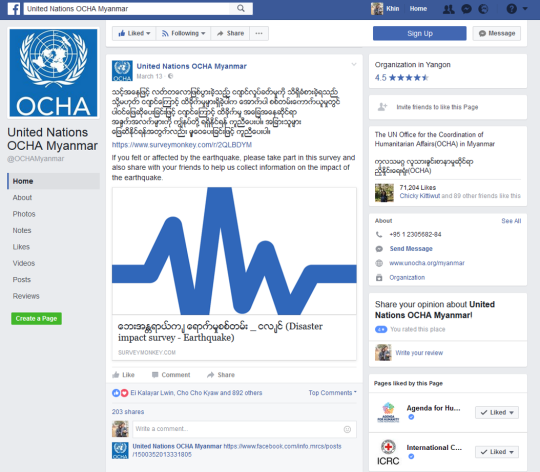
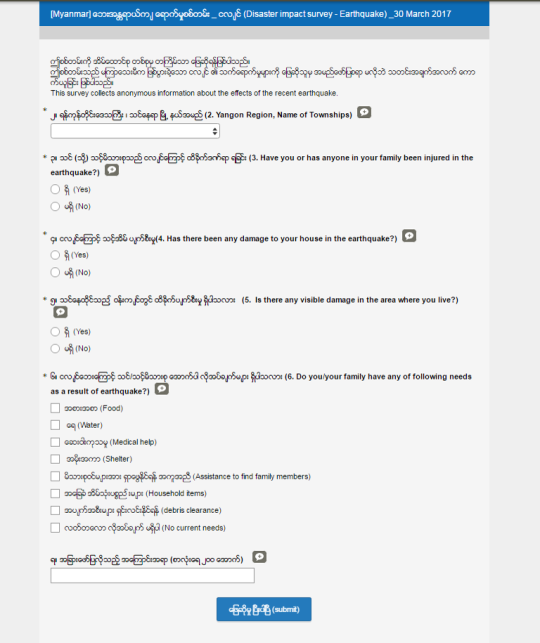 Although it is recognized that the survey results do not form a complete picture, OCHA Myanmar received vital information on the earthquake’s impact (damage to houses, initial needs of people, etc.) in first few hours. And once again, the results aligned with official results that came a few days later.
Given that the data is coming in a structured survey, the results can be almost instantly analyzed (see examples below). Rapid analysis provides many benefits to the responding community: We should be able to get a much better understanding of the situation within hours (vs days). We can ask more informed questions. We can make more informed decisions. We can identify possible hotspots of humanitarian need and prioritise those locations for assessment teams heading to the field. We can be more surgical in our first days of aid delivery. We can better respond to the affecteds’ needs. Combining it with the still needed more formal assessments, one can even imagine a smoother transition from the early days to longer-term humanitarian action to recovery to development.
I am really excited about how easy this solution turned out to be. Having leveraged major tools like SurveyMonkey and Facebook, I can see how this solution can be relatively easily scaled to other emergencies. And perhaps provide an interesting avenue for a concrete partnership between the humanitarian sector and private industry?
Kudos to Chris Hyslop, Pierre Perron, and especially Htet Htet Oo for making this happen in Myanmar. Hopefully it is the beginning of a larger change in how we collect information from populations affected by humanitarian crises.
If you would like to know more or learn from the OCHA Myanmar office, do get in touch.
Andrej