Cybersecurity and Humanitarian Organizations - On a Collision Course?
In 2014, the United Nations Office for the Coordination of Humanitarian Affairs authored a policy paper entitled Humanitarianism in the Age of Cyber-warfare. Four years, and countless cybersecurity and data breach stories, later, Emma Amaral and I chatted about the topic over tea and pondered how things had changed. From that conversation, a couple research questions were formulated: (1) how has the cyber landscape changed and what has the response of humanitarian organizations been? and (2) what ethical responsibilities do humanitarian organizations have to protect data collected from people they are trying to help, and what basic precautions should they be expected to take?
We found that humanitarian organizations had specifically become targets. And, sadly, we found that few had changed their cybersecurity practices. Actually, many had begun collecting even more data and introduced more advanced technologies without understanding the potential risks. One of the interviewees summed up the organizations’ mentalities when they said: “Since the 2014 OCHA cybersecurity report, humanitarian organizations are now a more informed cohort, and there is greater emphasis on community involvement regarding data use. However, this has not translated into practical applications of security practices.” Essentially, organizations seem to know that something should be done, but few are dedicating the necessary attention and resources. Thinking about it, actioning it, and talking about it publicly like the ICRC [PDF], is a great start. And, putting in place robust data policies are critical [PDF].
As you can imagine, the research resulted in many very interesting, complex and multifaceted conversations. In the end, we have compiled our findings and recommendations into a paper entitled Cybersecurity and Humanitarian Organizations - On a Collision Course?
 [PDF]
Recommendations to humanitarian organizations:
- Conduct risk assessments
- Build capacity: Staff expertise and training
- Partner with the private sector when the benefits outweigh the risks
- Change the organizational structure
- Improve the basic standards of cybersecurity practice
- Increase responsibility on donors for security funding and reducing stigma
- Improve communication between humanitarian organization
- Improve data policy as a whole and be consistent
- Develop an emergency contingency plan
Skeptical? Perhaps you are reading and are thinking that the concern is overblown? May I suggest that you read the below sampling of recent articles (and one documentary). Most were announced in just the past three months. Even just scanning the titles and dates will give you an idea of scale and frequency of cybersecurity related incidents.
- Pentagon secretly struck back against Iranian cyberspies targeting U.S. ships [PDF] - 21-June-2019
- Waterbug: Espionage Group Rolls Out Brand-New Toolset in Attacks Against Governments [PDF] - 20-June-2019
- After Hacker Seizes Government Computers, Florida City Agrees to Pay $600K Ransom [PDF] - 20-June-2019
- U.S. Customs and Border Protection says photos of travelers into and out of the country were recently taken in a data breach [PDF] - 10-June-2019
- Fortune 500 giant Tech Data exposed customer and billing data [PDF] - 7-June-2019
- At least 17 Kenyan government websites defaced in cyberattack: Local Source Photo via Twitter [PDF] - 3-June-2019
- In Baltimore and Beyond, a Stolen N.S.A. Tool Wreaks Havoc [PDF] - 25-May-2019
- Google’s GSuite passwords stored in plain text [PDF] - 21-May-2019
- Hack of Japanese Retailer (UNIQLO) Exposes 460,000 Customer Accounts [PDF] - 15-May-2019
- NSO Group’s Pegasus used to hack WhatsApp [PDF] - 14-May-2019
- Hackers Steal and Ransom Financial Data Related to Some of the World’s Largest Companies [PDF] - 30-April-2019
- Exposed database holds sensitive data on over 80 million US households [PDF] - 29-April-2019
- Major cybersecurity news in just one week [PDF] - TechCrunch - 21-April-2019
- The Stuxnet virus [PDF] from 2010. Zero Days documentary on the virus (2016)
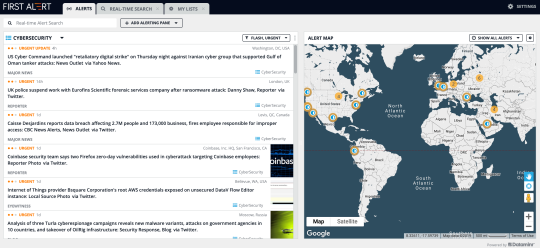
Or, perhaps leverage a tool like First Alert from Dataminr to monitor all the newsworthy cybersecurity incidents around the world.
 No matter how you look at it, the importance of cybersecurity is only increasing for humanitarian organizations. We collect data on some of the most vulnerable people and have staff working in some of the most dangerous places around the world. We owe it to them and ourselves to take cybersecurity seriously. Mainstreaming cybersecurity practices into humanitarian operations may very well be one of the largest challenges the sector faces in the coming decades, and will be necessary to maintain the public’s trust as we rely more on data to do our job.
Andrej