Framework for Humanitarian-Technology Research
A few years ago, a few of us explored the idea of how researchers and humanitarian organizations could work together. The focus was mostly about how collaboration could happen at the time of an emergency. Last month, UN-OCHA signed an agreement with Tilburg University intending to enable more research in the humanitarian-technology nexus (outside the times of an emergency) by leveraging Masters or PhD-level students.
In my initial discussions with Kenny Meester, we quickly realized that such researchers will need to think through their possible topics and be guided to an achievable scope. We needed something that a researcher could go through on their own, ask themselves the hard questions, and make a decision. This need lead to a simple, two-page Humanitarian-Technology Research Framework.
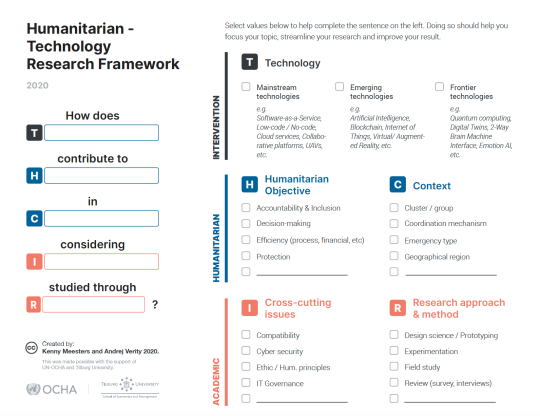 [
As researchers use this framework, our intentions are to capture the answers and categorize their resulting papers accordingly. Over time, we hope that this collection will become a repository for both responders and researchers to leverage.
Our first batch of researchers have all completed their theses and are now working on the shorter and more guidance-oriented, public-facing version. Over the coming months, we are expecting to release papers on:
- Calculating the Cost of Humanitarian Data Collection;
- 21st Century Humanitarian Information Manager: A modern competency framework;
- How to leverage emerging or smart networks to increase humanitarian collaboration; and
- Cyberbullying within remote (virtual) responder groups.
Andrej