How much did that cost to collect?
When talking to people about humanitarian response and decision making, we often land on the topic of data and the need for solid data to make sound decisions. In that discussion, I often open up a few questions about how much it costs to collect the necessary data for any given decision. Is the return-on-investment sufficient for the given decision? Is the opportunity cost of collecting data for one decision appropriate if you cannot collect sufficient data for another decision? Can you collect the right data in time? What happens if you try to collect more data than you need for a decision?
A rather old story that I relay in such conversations is about a (former) senior OCHA officer demanding the organization collect visa-related information related to an unfolding sudden onset disaster. Since this is not the usual type of data OCHA would collect, it meant countless staff went scrambling and the process was ad hoc, manual and messy at best. Countless people calling Missions, UN agencies, international and national NGOs, and responders in-country. By the time a decent picture was emerging, the issue had largely passed, the senior official did not really use the results, and the organization had spent a lot of money. Could that money have been spent better elsewhere? Perhaps. But, hindsight, as they say, is always 20-20.
Over the years, this story has stuck with me. I watched, participated in and initiated countless data collection processes without asking questions about the cost up front. Let me be clear: I am not against data collection. Quite the contrary. It was great to see the OCHA USG and President of The Rockefeller Foundation release an op-ed about investing in data [PDF]. More investment is a good thing. My concern is about understanding how much the collection will cost and how/if the result will be used to make a decision. Are the costs appropriate?
It is with this view that I was happy to join up with Alex Muller and Kenny Meesters to explore the topic of trying to define how such costs could be calculated before a collection exercise starts and how the various factors could be influenced to reduce costs.
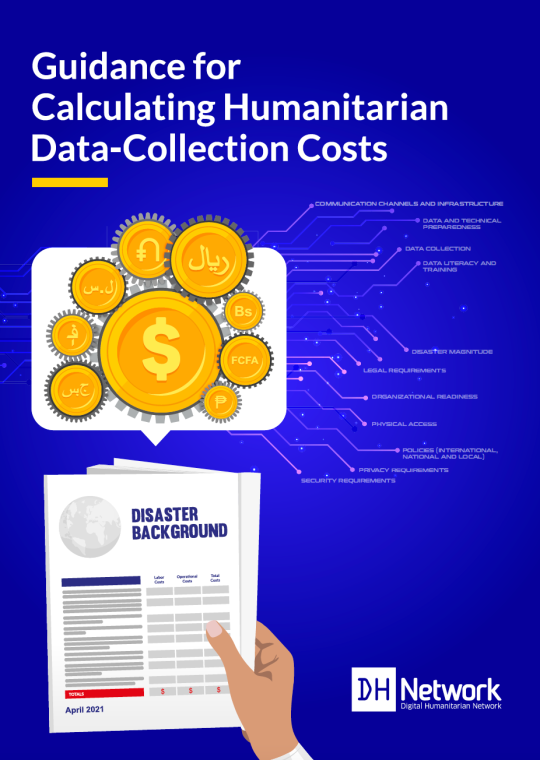
The result is a short guidance document entitled Guidance for the Calculating Humanitarian Data Collection Costs. It outlines the concept, the various constructs/attributes that affect cost, a template table to calculate costs and a fictitious example. The intention is to keep things simple and easy to apply. Kind of back-of-the-napkin exercise so that you can be better informed: will the cost be worth it?
 [PDF]
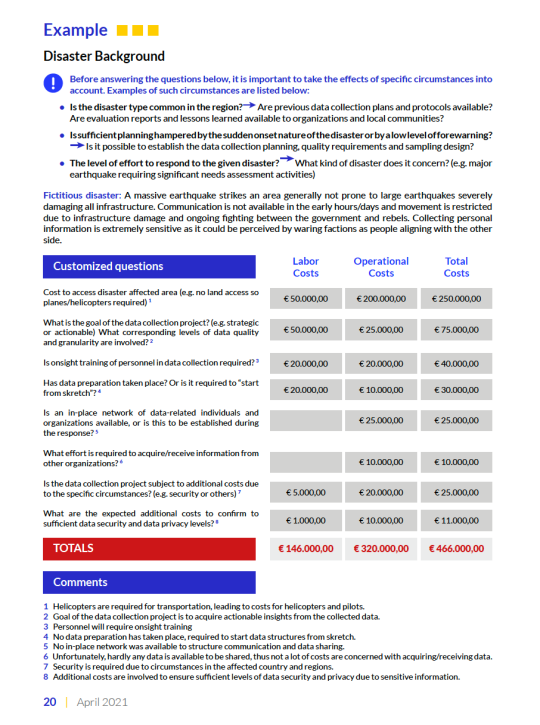
Fictitious example included in the guidance document:
 As I mentioned early on. I am not against data collection. Quite the contrary. I just believe in doing so with our eyes open.
Andrej