Let’s get to know each other: Academics & Humanitarians
Oftentimes when I see a humanitarian engage academia for the first time, there is usually a misunderstanding on what academia can or will do. No, academia is not there for humanitarians to treat like a consultant. And, yes, that is the most common misunderstanding I tend to see. Such an expectation quickly leads to disappointment and a perception that academia cannot deliver anything of value to the sector.
On the flip side, I have seen academics who approach the humanitarian sector for the first time without a solid understanding of the how and why we do things. Our quick and sometimes unscientific decisions during a disaster are not always easily understood or appreciated. Trying to help a sector that is bouncing from one crisis to the next, without noticeable improvements, can lead to great frustration.
Of course, there are great people on both sides and there have been (and continue to be) great collaboration and impressive results. However, I would argue that a lot more could be happening. Could we better outline a way to understand each other from the very start?
Working with Husnah Mad-hy, Kenny Meesters and a few other people on both sides, we have drafted a VERY cliche matrix that outlines what each side should know about the other. (Yes, I would like to stress that these are VERY cliche.) In my opinion, this is the first framework you might show someone who is about to collaborate with the other side for the first time. Just to get them in the right mindset and to hopefully not be surprised by their collaborator(s) approach. Let’s try to get things started off on the right foot.
The result: 10 things we should know about each other: Academics & Humanitarians
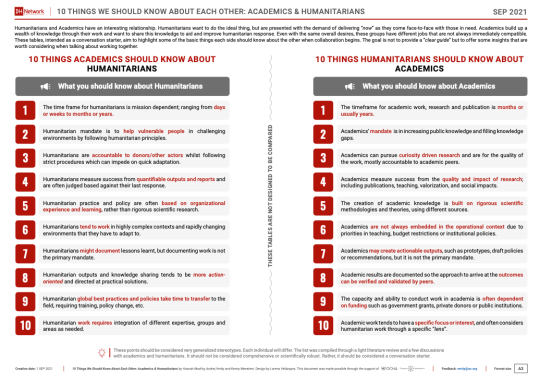 [PDF]
Although not planned, we have discussed the idea of expanding this matrix approach into a series comparing a variety of groups. If you are interested in helping, please get in touch.
Andrej