Shall we shift the IM game?
Even pre-COVID, I was quite interested in which Information Management work could be done outside of a disaster area. In the early 2010s, I collaborated with distributed technical groups while responding to emergencies and even helped establish the Digital Humanitarian Network. When leading OCHA’s information management response to Typhoon Yolanda in 2013/14, I held back many of OCHA’s IMOs from the front line. One IMO per sub-office was deployed and the remainder stayed in Manila supporting the forward line. Did we really need to flood the disaster areas with more people? No. Could we put people in a location with good internet and comfortable surroundings and still deliver at the level expected of OCHA? Yes. Yet, it was clearly an uncomfortable feeling for management. I got several questions and many hints of concern about the optics (vs looking at the results). It did not yet seem that people could understand the possibility of remote work.
Fast forward to the COVID-era and things have changed. Many people have come to realize that remote work is not only possible, but perhaps better sometimes. So, perhaps now is the time to shift the IM game?
I am not suggesting that we remove capacity from the field completely. I am actually suggesting that we add capacity….but that it is added remotely*. Let’s take OCHA as an example. What if for each OCHA office, we had two IMOs working from elsewhere in the world? The Venezuela office could get support from people in Mexico and Spain. The Mali office could get support from people in France and Senegal. The Yemen office could get support from people in Egypt and Germany. The Philippines office could get support from people in Thailand and New Zealand. The combinations become endless when we open up about where our team members can be located.
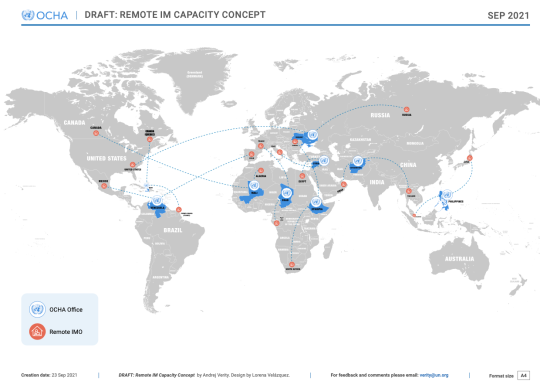 [PDF]
If these remote IMOs were part of a global team, each with their regular client office, we could also prepare them to respond to sudden onset disasters around the globe. A subset could be quickly formed into a Virtual Response Team as needed.
Unfortunately, a shift like this takes a significant investment as such staffing levels would not come free. With approximately 35 OCHA offices, that would be 70 IMOs plus the management and administrative costs (e.g. licenses, telecommunications, etc). So, if you are reading this and know a forward-looking donor, please share the idea or send me their details. Or, if you are an OCHA IM Partner and want to help make this happen, please get in touch.
My work email is verity[at]un.org.
Andrej
Upcoming publication: Pre-COVID, I had started looking at building a handbook to help manage remote disaster response teams. Sariel Lei joined me earlier this year to work on the topic. It has been drafted and is undergoing editorial review. Hopefully we will have it ready to share in the next couple months.
*My experience tells me that we still need a person in the country who can translate in-country requirements to a remote group of people, I am not suggesting IM is removed from the disaster area completely. We need a small footprint which includes someone who understands how to task and manage remote capacity, has the ability to be online constantly, is collaborative in nature, is communicative & transparent by default, and is able to make decisions. Very much a 21st Century IMO.