A Quantum Leap: A Looming Threat to Our Digital Security
A Quantum Leap: A Looming Threat to Our Digital Security
While much of the world is buzzing with excitement about the potential of artificial intelligence, quantum computing is quietly taking big steps. And, while quantum computers offer some truly amazing possibilities, such as solving complex problems and accelerating scientific discovery, it is important to acknowledge the darker side especially in regards to our current digital security infrastructure.
In recent months, there have been growing concerns about the potential impact of quantum computing on our digital world. A prime example is the recent news of Chinese researchers breaking RSA encryption (PDF) using a quantum computer. While experts have cautioned against overstating the significance of this achievement (PDF), it serves as a stark reminder of the looming threat.
This threat is amplified by the concept of “store-now-decrypt-later” attacks. Malicious actors could potentially intercept and store encrypted data today, knowing that future quantum computers could decrypt it. This insidious strategy could compromise sensitive information, such as financial records, intellectual property, and personal data.
 Mosca’s Theorem: A Ticking Time Bomb
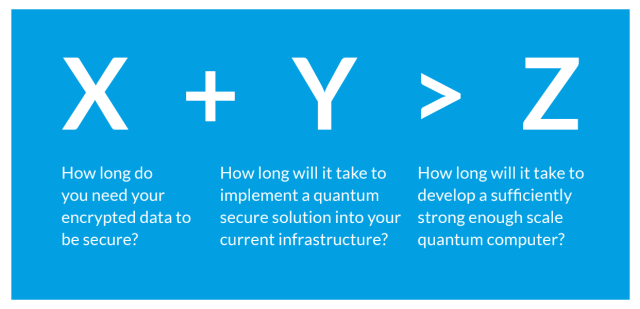
In 2023, I started to re-explore the concern surrounding quantum security with Cameron Vrckovnik. During our collaboration, we came upon Mosca’s theorem created by Dr. Michele Mosca. The theorem helps one easily and quickly assess the urgency of the quantum security threat. This theorem introduces three key variables:
- X: The time an organization needs to keep data secure.
- Y: The time required to migrate to quantum-resistant encryption.
- Z: The estimated time to build a powerful quantum computer.
If X + Y > Z, then the organization’s data is already at risk. Even if a quantum computer isn’t available today, it could be built before the organization can fully migrate to quantum-resistant encryption.
For example, consider an organization that collects and stores biometric data. If this data needs to be protected for 40 years, and it takes 5 years to migrate to quantum-resistant encryption, and a powerful quantum computer could be built in 30 years, then the organization’s data is already vulnerable (40+5 > 30).
 A Glimpse into the Future
To gain a better understanding of the industry’s response to this threat, I attended QuTech’s Quantum for Business Roundtable at TU Delft in November 2023. It was encouraging to see both private companies and public sector organizations actively working to quantum-proof their systems and data. There were still lots of questions and uncertainty. But, organizations with critical infrastructure had accepted both the possibilities and the related challenges.
Given the urgency of the situation, organizations must take immediate steps to prepare for the quantum era. By assessing vulnerabilities, developing migration plans, and investing in quantum-safe technologies, we can safeguard our digital future.
When I started in the humanitarian sector about 20 years ago, I was told a joke that “humanitarian innovation is just doing what the private sector did 5-10 years ago”. Unfortunately, quantum security is so critical that no industry can afford to simply sit back and wait for others to solve their problems. Rather, we will need to work hand-in-hand with the private industry, standards bodies, and government entities to ensure our digital landscape remains safe.
Andrej
——
Details / Disclaimers:
- Google Gemini used to brainstorm and support in drafting
- First image generated by Google’s Gemini. Although adjusted, the main prompt was “Would you be able to create me an image to go with the blog post? I am thinking of an image of a panel from a 1950s sci-fi comic where a quantum computer is somehow shown to be cracking open the data being sent to/from a laptop of 2024?”