The Armchair Technologist. Part one
The Armchair Technologist. Part one
In today’s digital age, technology has seeped into every aspect of our lives, from the mundane to the extraordinary. Yet, there’s a growing trend of individuals who are deeply interested in technology, who follow its advancements closely, and who even discuss it passionately, but who have never actually written a line of code or worked as a citizen developer. I recently coined the term ’Armchair Technologist’ to describe such individuals.
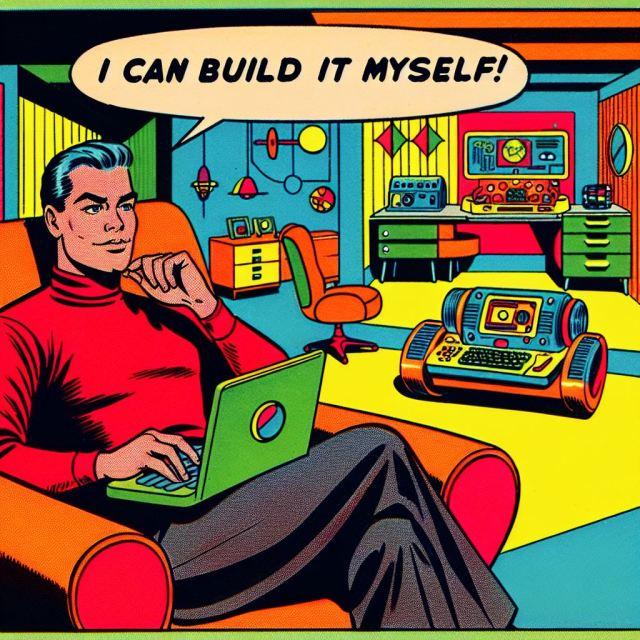
For me, an armchair technologist is either (1) someone who projects an air of deep knowledge about technology, yet lacks the practical experience or training to back it up or (2) someone who was once technologically savvy, but has moved into more managerial roles and has not kept up with the rapid change of technology. Similar to the “armchair quarterback” who critiques sports teams from the comfort of their comfy armchair or sofa, the armchair technologist offers theoretical advice that can be superficial and oversimplified, misleading, or even incorrect.
 Identifying the Armchair Technologist
So, how can we spot an armchair technologist? In my experience, I would say that an armchair technologist emphasizes theoretical concepts gleaned from articles or social media, rather than hands-on experience building, troubleshooting, or implementing technology. They often imply work will be simple and are “hand wavy” in their explanations. They are often overconfident in what they believe can be done especially if they have a technical team under their command. For example, an armchair technologist might suggest implementing a complex AI solution without considering the necessary infrastructure or data requirements.
Have I become one myself?When I first used the phrase armchair technologist, I was using it as a bit of a tongue-in-cheek way to describe how I recently started to feel with the rapid advancement of AI - given my study of the topic was in the late 90s. But, over time, I started to really question myself: had I become an armchair technologist?
In my self reflection, I came across the Dunning-Kruger Effect, a cognitive bias. It describes the tendency of people with limited knowledge to overestimate their abilities. In the context of technology, someone new to a complex field like cybersecurity or quantum computing might be more likely to make pronouncements based on limited understanding. Some researchers also include the opposite effect for high performers: their tendency to underestimate their skills. I am not sure where I fit exactly. Hopefully more toward the high performer that underestimates themself. Regardless, I realized that I needed to:
- Embrace a Growth Mindset: Cultivate a desire to learn and adapt, acknowledging that technology is constantly evolving. Continuous learning is critical.
- Seek Reliable Sources: Look for information from reputable sources like tech journals, academic papers, and conferences hosted by industry experts.
- Practice Humility: Don’t be afraid to admit when I don’t know something, and actively seek out opportunities to learn from those with deeper expertise.
By acknowledging the existence of the armchair technologist within ourselves and others, we can promote better communication and understanding within the ever-changing world of technology.
The Future of the Armchair Technologist
Given the rapid pace of technological advancement and the increasing prevalence of user-friendly, no-code/low-code solutions, it is probable that the number of armchair technologists will continue to grow. Bubble recently noted (PDF) that, by 2030, no-code will be the primary solution used to create software applications. As technology becomes more accessible to non-technical users, it can empower individuals to solve problems, automate tasks, and innovate without needing extensive coding knowledge. In an even more aggressive stance Matt Garman, Amazon’s Cloud Chief, recently talked (PDF) about how developers may stop coding when AI takes over in a couple years: “Coding is just kind of like the language that we talk to computers. It’s not necessarily the skill in and of itself. The skill in and of itself is like, ‘How do I innovate? How do I go build something that’s interesting for my end users to use?’”. Essentially, developers will be working at a higher level of abstraction. The traditional triad of designer, developer, and product manager will have collapsed into a single role. Could a savvy Armchair Technologist fit that role?
In future posts, I will delve deeper into the potential benefits and drawbacks of the armchair technologist. How can they can drive innovation and democratize access to technology, but also how they can lead to unintended consequences, such as increased cybersecurity risks and a decline in technical expertise.
Andrej
———
Disclaimer:
- Google Gemini used to brainstorm and help with drafting
- DALL-E 3 was used to create the image with a prompt of: create an image of a panel from a 1950s sci-fi comic where a non-gendered person sits in an armchair with a laptop on their lap and a speech bubble from the person saying “I can build it myself!”