Humanity in the Loop: Principled AI Adaptation for Humanitarian Organizations
Humanity in the Loop: Principled AI Adaptation for Humanitarian Organizations
In the conversations that I have joined over the past few years that discuss the intersection of artificial intelligence and the humanitarian sector, they always circled back to the same tension. Everyone is using these tools on their phones and laptops, yet organizations are struggling to figure out how to adapt. So, to dig into this properly, I brought in Sophie Byrne to help me explore the hard question: What do humanitarian organizations, especially those with an information or coordination focus, need to do in order to remain relevant and even thrive in the AI era?
Sophie did the heavy lifting on this research, combining a comprehensive literature review with insights from expert key informants across the sector. Today, we are thrilled to launch the resulting report: Humanity in the Loop: Principled AI Adaptation for Humanitarian Organizations.
 [
AI adoption is already happening organically across the sector, but organizational adaptation is lagging far behind. Individual staff members are moving fast, yet formal policies and readiness structures remain scarce. To bridge this gap, organizations must focus on a structured approach rather than a simple, unplanned acceleration of AI adoption. Improvements and efficiencies must have a purpose - for example, organizations must ensure saved time is actively re-allocated to more impactful work, rather than simply absorbed by administrative creep.
To help organizations navigate this shift, the paper outlines a comprehensive framework built around four key pillars:
- Human expertise and judgment. Organizations must protect critical thinking through universal AI literacy, meaningful oversight, and deliberate pathways to preserve human expertise against automation bias. Furthermore, organizations must deliberately protect entry-level tasks and junior staff development to ensure future expertise is not drained before it can be cultivated and built.
- Organizational learning and adaptation. Shifting toward strategic AI use requires building a safe culture of learning, executing intentional pilots designed for knowledge generation, and breaking down destructive institutional silos.
- Responsible design and governance. Innovation must be paired with practical, tiered governance that matches oversight to risk, robust data foundations, and careful design that protects affected populations.
- Ecosystem coordination. The humanitarian community must share knowledge and infrastructure openly, strengthen local capacity to prevent widening divides, and protect human relationships and trust.
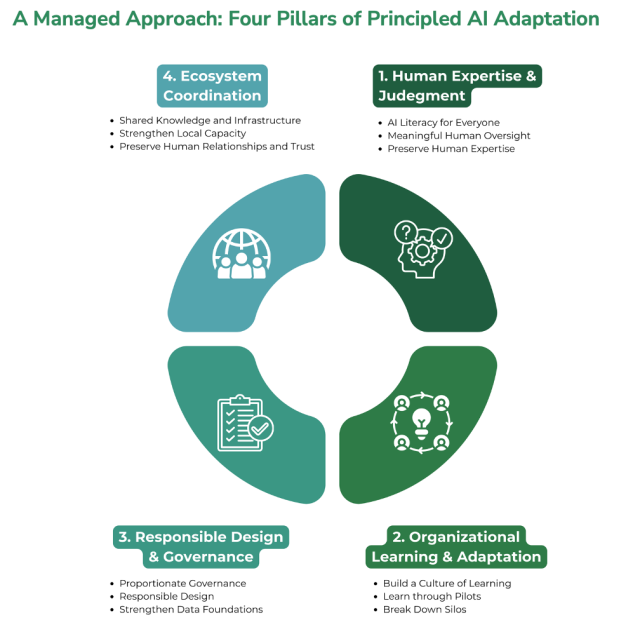 This framework was intentionally designed so that most any organization could easily take and adapt it to their own operational contexts, using it as a stepping stone to structure their internal discussions and policies.
Andrej