Can We Measure Whether Our Use of AI Is Becoming More Responsible?
Can We Measure Whether Our Use of AI Is Becoming More Responsible?
Over the past few months, James Brennan and I have been exploring what seemed like a simple question: How can an organisation demonstrate that its use of artificial intelligence (AI) is becoming more responsible over time?
There is no shortage of AI frameworks, principles and maturity models. We reviewed a number of existing and emerging approaches, including the National Institute of Standards and Technology (NIST) AI Risk Management Framework (AI RMF), the ProSocial Index, the European Union Assessment List for Trustworthy AI and the Gartner AI Maturity Model. Each offers useful perspectives, but we struggled to find something that felt simultaneously relevant, practical and easy to implement for organisations that are still early in their AI journey. And, most importantly, we wanted a framework that could be lightweight or sophisticated, depending on an organisation’s needs.
That led us to start developing an AI Responsibility Indicator System.
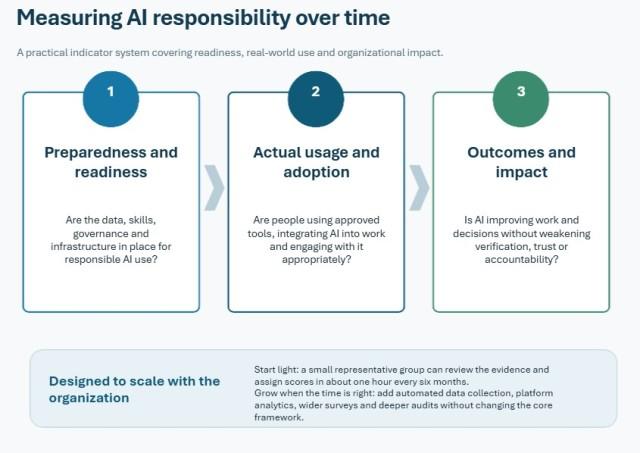 [
Rather than focusing on a single AI application, we look across six pillars that influence responsible AI adoption
- Data: do we have information that AI can access, trust and use effectively?
- Skills: do our people have the knowledge and confidence to use AI responsibly?
- Governance: do we have the oversight, accountability and controls needed to manage AI safely?
- Infrastructure: do our systems, information and processes enable AI to work at scale?
- Adoption: are people actually using approved AI tools in meaningful ways?
- Outcomes: is AI delivering measurable value while maintaining trust and accountability?
Together, these pillars examine organisational readiness, actual use and the results/outcomes AI is producing.
At the simplest level, a small group of representative stakeholders could spend an hour every six months reviewing evidence and assigning scores against a set of indicators. That creates a baseline, highlights gaps and allows progress to be tracked over time. At the other end of the spectrum, organisations could introduce automated data collection, platform analytics, surveys and formal audits.
The objective is not to create a perfect score, but rather to create a credible way to answer questions such as:
- Are we becoming better prepared to use AI responsibly?
- Is adoption occurring in the right places and in the right ways?
- Are we seeing measurable benefits without compromising accountability, oversight or trust?
- Can we demonstrate progress to leadership, auditors and other stakeholders?
The framework remains an early draft and will continue to evolve. We are particularly interested in the ongoing Inter-Agency Standing Committee (IASC) work on responsible AI in humanitarian action and expect to adapt this thinking as broader sector guidance emerges.
For now, I am sharing the concept for feedback.
What is missing? Which indicators matter most? And how would you measure whether your organisation’s use of AI is becoming more responsible over time?
Andrej